Deciding whether to repair or pursue air conditioner replacement can feel urgent when a system struggles on a hot day. A single breakdown does not always mean the equipment must go. The better decision comes from looking at the unit’s condition, repair history, comfort across the home, and the plan for the building—not age alone.
Discuss your cooling system with Bay-Care
When should you consider air conditioner replacement?
Consider a replacement evaluation when problems repeat, repairs become more involved, or the system no longer keeps rooms comfortable. These signs are reasons to investigate, not proof that replacement is the only option:
- Repeated service calls: A pattern of separate failures may change the value of another repair. Keep invoices and note which parts were addressed.
- Uneven temperatures: Rooms that remain warm while the thermostat area feels cool can point to airflow, duct, insulation, or equipment concerns.
- Long or frequent cycles: If the unit runs for extended periods without meeting the thermostat setting, a technician can check operation and the home’s cooling load.
- New noises, odors, or moisture: These symptoms deserve prompt assessment. Do not assume they can be solved by changing equipment alone.
- A planned renovation or change in use: Added space, new windows, or a different occupancy pattern may affect what the home needs.
- Rising concern about operating costs: A change in bills can have several causes, including weather, controls, airflow, or building conditions. It is a reason to investigate rather than a reason to select a specific model immediately.
Start with the specific symptoms and their timing. A unit that fails once after many steady seasons presents a different question from one with recurring issues and comfort complaints. For basic checks before arranging service, review Bay-Care’s air conditioning troubleshooting guidance, but do not open electrical panels or handle refrigerant.
How do you compare repair with replacement?
Ask for a clear explanation of the diagnosed problem, the repair proposed, and what is known about the rest of the system. Compare the repair’s immediate purpose with the broader cost and disruption of installing new equipment. No single age cutoff or rule of thumb can decide the question for every home.
| Consideration | Repair may fit when… | Replacement evaluation may fit when… |
|---|---|---|
| Equipment condition | The issue is identified and the remaining system appears serviceable. | There are recurring faults or concerns beyond one repair. |
| Repair history | This is an isolated problem with a clear remedy. | Multiple repairs have accumulated or symptoms return. |
| Comfort | The system generally cools the home evenly after repair. | Persistent hot rooms or long cycles need a whole-system review. |
| Project timing | You need to restore cooling and the repair is appropriate. | You can compare proposals and plan installation before a failure. |
| Building changes | The home and its use have not changed significantly. | Renovations, duct changes, or insulation concerns may affect sizing. |
| Scope of the problem | The repair addresses a confirmed, limited failure. | The diagnosis raises questions about several connected components. |
Use the table to organize questions, not to substitute for diagnosis. Ask the technician to separate what is confirmed from what remains uncertain. You can then compare a repair estimate with a replacement proposal on the same basis, including what each option does and does not address.
What does a repair estimate tell you?
A repair estimate should identify the failed or questionable component and explain the expected result of the work. It should also distinguish a temporary restoration from a broader correction. For example, replacing one failed control may restore operation, but it may not resolve an airflow problem or a hot upstairs room. Ask whether the technician observed other conditions that could affect the result.
Do not evaluate a repair only by its price. Consider how the repair fits the system’s current condition, whether parts are available, and whether the same symptom has appeared before. A written record is useful if you later request a second opinion or compare replacement options.
What should an air conditioner replacement evaluation examine?
A useful evaluation looks beyond the outdoor unit. The indoor coil, blower, controls, duct system, insulation, air leakage, and the rooms that feel uncomfortable can all affect performance. If a contractor recommends a larger or smaller system, ask what measurements and calculations support that selection.
Bring practical information to the appointment: recent repair invoices, utility concerns, thermostat settings, rooms that are hard to cool, and any renovation plans. A simple room-by-room description can help direct the inspection. For example, note whether an upstairs bedroom is warm all afternoon, whether a closed-off room is affected, or whether the whole home takes too long to cool.
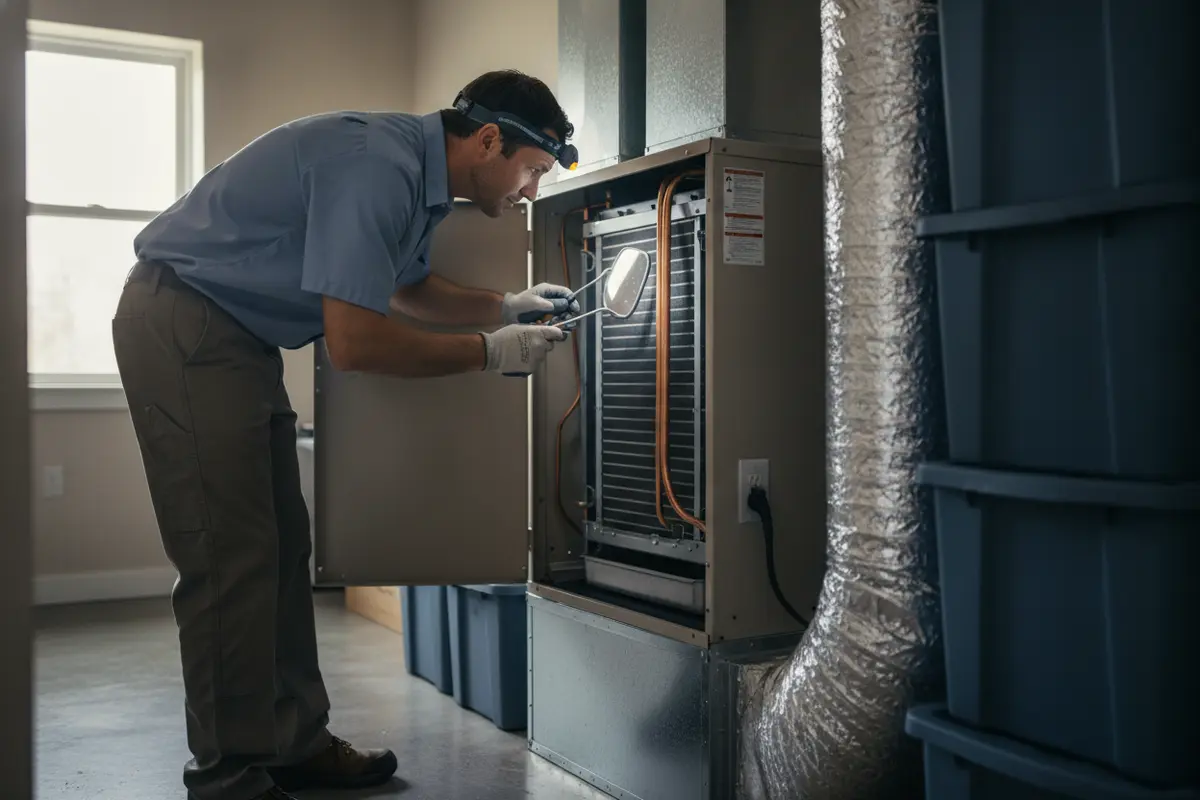
Ask whether the proposal includes reviewing airflow and ducts, not just selecting equipment. Leaky or poorly balanced ducts can undermine comfort even with new equipment. Bay-Care’s energy audit service and duct sealing information describe related parts of a whole-home assessment.
How do sizing and airflow affect the result?
Equipment capacity should be matched to the building and the distribution system. A larger unit is not automatically a better answer for a warm room. If it cycles differently from the existing equipment, or if ducts cannot deliver air where it is needed, the underlying comfort complaint may remain.
Ask how the contractor considered the home’s layout, insulation, windows, air leakage, duct condition, and expected use. Also ask whether the indoor and outdoor components are designed to work together. These questions help keep the conversation focused on the whole system rather than a box on a sales sheet.
Which details should you compare in replacement proposals?
Proposals can be difficult to compare when they list different equipment or leave out installation details. Ask each contractor to explain the recommended capacity, efficiency information, included work, and any assumptions. A proposal should make clear what is being installed and what work is included.

- System match: Confirm the proposed equipment is compatible with the home and existing components, or that required changes are identified.
- Scope: Ask what happens to the indoor coil, blower, thermostat, refrigerant lines, condensate drainage, electrical connections, and duct transitions.
- Capacity and efficiency: Request the reasoning behind the size and the efficiency information for the complete matched system, not just one component.
- Startup and testing: Ask what checks are performed after installation and how the contractor verifies system operation.
- Warranty terms: Request the written manufacturer and labor terms, including any registration or maintenance conditions.
- Permits and disposal: Clarify who handles applicable permits and removal of old equipment.
- Schedule and access: Understand the expected work window and what the household should prepare.
- Future service: Ask what documentation you will receive and who to contact if a question appears after startup.
Efficiency labels are useful for comparing products, but real results also depend on sizing, installation, controls, and the building. Avoid choosing by a single rating or by the lowest initial price without understanding the scope. Bay-Care provides information about its air conditioning installation service to help homeowners explore next steps.
How can you compare the proposals fairly?
Place proposals side by side and mark differences in scope. One may include a thermostat or duct transition while another assumes those items are usable. One may describe removal and startup testing while another leaves them unstated. Ask for revisions when an important assumption is unclear rather than treating an omitted item as included.
Compare the proposed outcome as well as the equipment. If your main concern is an upstairs bedroom, ask each contractor how the proposal addresses that room. If humidity is the concern, ask what part of the plan addresses moisture. This approach makes it easier to distinguish a complete response from a simple equipment swap.
How can Delmarva conditions affect the decision?
Delmarva homes face hot, humid summer weather, and coastal locations can expose outdoor equipment to salt air. If a home is near the coast, ask how the proposed equipment and its placement suit the site and what care is recommended. Bay-Care offers information on coastal HVAC corrosion protection; ask whether it is relevant to your equipment and location.
Humidity and comfort concerns also deserve attention. If the home feels clammy even when the thermostat reaches its setting, discuss moisture control and airflow as part of the evaluation. The answer may involve more than replacing the cooling unit. A whole-home indoor air quality review can provide context for related concerns.
Coastal exposure is only one site factor. Attic conditions, duct placement, sun exposure, and the way rooms are used can also influence comfort. Explain these conditions during the visit so the recommendation reflects the home rather than a generic replacement scenario.
What does research say about replacement timing?
Replacement timing is a decision about the condition and expected service of equipment, the cost of maintaining it, and the needs of the household. Research from the University of Michigan Center for Sustainable Systems examines life-cycle optimization for residential air conditioner replacement and shows why the question involves more than the purchase price alone. Read the research on air conditioner replacement timing. It is a general framework, not an individualized recommendation for your home.
Use that kind of information as context, not as a promise of savings or a fixed replacement schedule. Your decision still depends on the diagnosis, installation scope, building conditions, and how long you expect to remain in the property. A clear comparison of immediate and longer-term considerations is more useful than relying on one universal rule.
How can you prepare before scheduling?
A little preparation can make a service conversation more productive:
- Write down the model and serial information if it is safely visible on the equipment label.
- List recent symptoms, when they occur, and which rooms are affected.
- Gather repair records and note any recent changes to the home.
- Record thermostat settings and whether the system reaches them during the problem.
- Identify your priorities, such as restoring cooling, improving room-to-room comfort, reducing humidity, or planning around a renovation.
- Make a short list of questions about sizing, ducts, controls, installation scope, permits, warranties, and startup testing.
- Ask for written options with scope, assumptions, warranty details, and next steps clearly stated.
Before the visit, check that the equipment area is accessible and that the technician can see the thermostat and relevant indoor components. Do not move heavy objects, remove panels, or attempt to test wiring. If the system has stopped cooling, use Bay-Care’s no-cooling guidance for basic direction, then arrange professional help when needed.
Do not delay a safety concern or attempt repairs involving wiring, refrigerant, or internal components. For an evaluation or service question, use Bay-Care’s contact page. Homeowners can also review common air conditioning questions before the visit.
How do you organize the decision after the evaluation?
Once you have a diagnosis and written options, separate urgent needs from planning decisions. Restoring safe operation may come first. Selecting a new system, improving ducts, or addressing insulation may require more comparison. Write down what each option solves, what it leaves unresolved, and what assumptions support it.
Then consider the household timeline. A homeowner preparing for a renovation may want the evaluation to account for the planned changes. Someone dealing with a sudden failure may need a practical repair or replacement path quickly. Neither situation makes one answer universally correct. The useful goal is to make the tradeoffs visible and choose an option that fits the building and the people using it.
Frequently asked questions about air conditioner replacement
Does an older air conditioner always need replacement?
No. Age alone does not diagnose a failure or determine whether replacement is the best choice. Have the system’s condition, repair history, comfort performance, and the home’s needs assessed together.
Can a new air conditioner fix a hot room?
Not necessarily. Airflow restrictions, duct leakage, insulation, sunlight, or system sizing may contribute. Ask for an evaluation that includes the room and the distribution system before assuming new equipment will solve it.
Should I replace the system during an emergency?
If cooling has failed, first establish what is wrong and whether a repair is appropriate. When replacement is being considered, ask which decisions must be made immediately and whether there is time to compare written options.
What should I do with my repair records?
Keep invoices and note the dates, symptoms, and components involved. This history helps a technician see whether the problem is isolated or part of a recurring pattern.
What if the proposed replacement is a different size?
Ask what measurements or calculations support the change and how the existing ductwork will accommodate it. A different capacity may be appropriate, but the explanation should connect the recommendation to the building and its comfort needs.
Explore air conditioning installation options
The right next step is a clear evaluation of the equipment and the home, followed by options you can compare with confidence.