A furnace blowing cold air can mean a simple thermostat setting, a restricted filter, or a problem that needs professional attention. Before opening the equipment cabinet or trying to reset a safety control, use a few safe observations to identify what is happening and decide when to call for heating service.
Ready to get help? Call Bay Care at (302) 245-3365 or request furnace service online.
A furnace may blow cool air briefly during startup, but air that stays cold or returns to cold after a short period can signal a thermostat, airflow, ignition, flame-sensing, blower, duct, or equipment problem. Bay Care helps Delmarva homeowners separate safe user checks from issues that require a trained HVAC technician.
This guide focuses on forced-air furnaces in homes across Maryland and Delaware. It does not replace an equipment manual, a carbon monoxide response plan, or an in-person diagnosis. If you smell gas, see smoke, hear a carbon monoxide alarm, or feel unsafe, leave the area and contact emergency services from outside.
Why Is a Furnace Blowing Cold Air?
A furnace can blow cold air when the thermostat is set incorrectly, the fan is running between heating cycles, airflow is restricted, or the burners are not producing heat. A high-efficiency furnace may also pause because of a drain or safety control. Bay Care diagnoses the complete heating system instead of guessing from airflow alone.
A forced-air furnace pulls cooler room air through return ductwork, heats it, and sends the warmed air back through supply registers. The Air-Conditioning, Heating, and Refrigeration Institute explains how furnaces move heat through a heat exchanger and ductwork. Electric furnaces use heated elements, but both types depend on the blower and duct system to distribute air.
Cold air from a register does not always mean the furnace is broken. The blower may run for a short period before the heat exchanger reaches operating temperature, or it may continue briefly after the burners shut off. The key questions are how long the air stays cool, whether the home reaches the set temperature, and whether any warning signs accompany the symptom.
Is Cold Air During Furnace Startup Normal?
Briefly cool air can be normal while the furnace starts or while the blower clears remaining air from the ducts. It is not normal for the air to stay cold through a complete heating call, for the furnace to cycle repeatedly without warming the home, or for safety warnings to appear. Bay Care can verify the sequence.
When the thermostat calls for heat, the system may complete several steps before warm air reaches the registers. A gas furnace may begin with an inducer motor, ignition sequence, and flame confirmation. The blower can start after the heat exchanger warms. An electric furnace may energize heating elements before the blower reaches normal airflow.
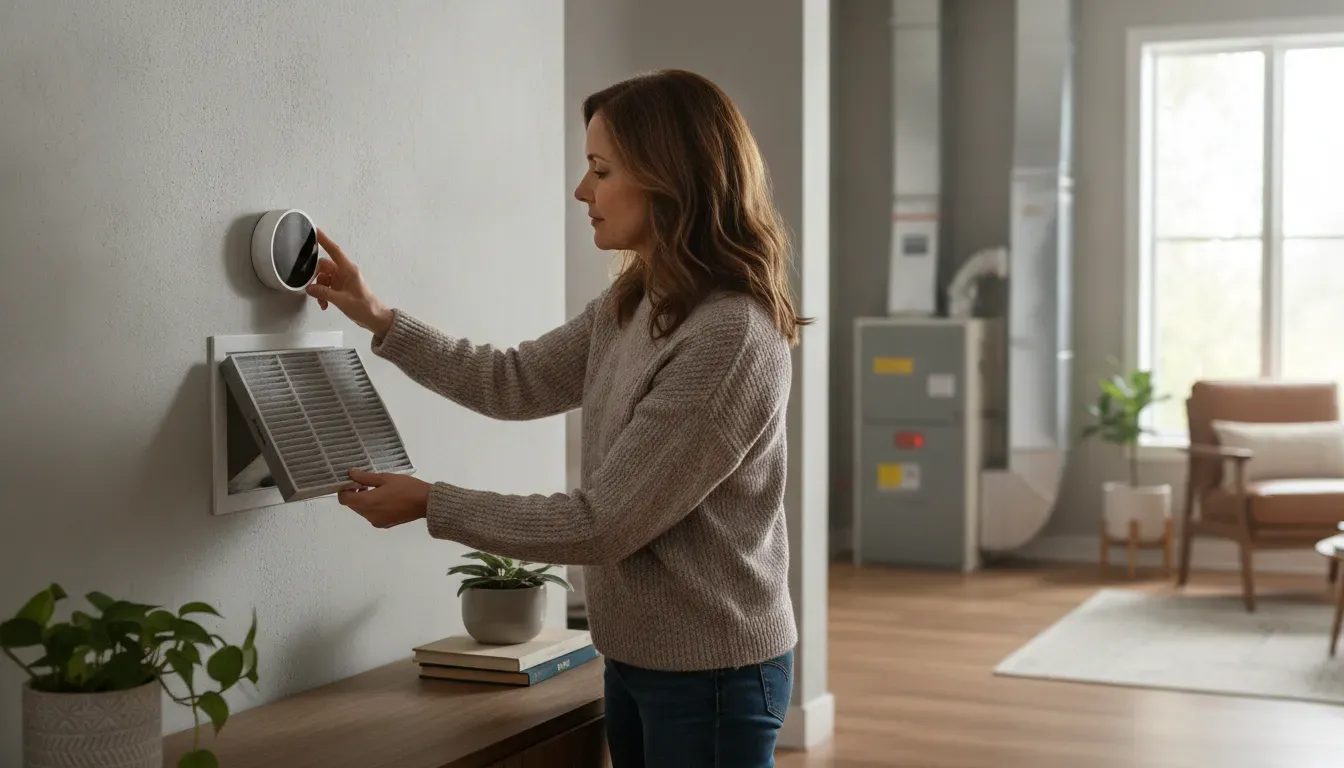
To observe the pattern, note the thermostat setting, the room temperature, when the fan starts, and how long the air remains cool. Check more than one register. If every register is cool and the furnace continues running, the issue is more likely to involve heat production, a safety shutdown, or a control problem than one isolated register.
What Safe Checks Can You Try When a Furnace Is Blowing Cold Air?
Start with the thermostat, accessible filter, and room registers. Confirm Heat mode, raise the setpoint slightly, set the fan to Auto, replace a visibly loaded filter with the correct size, and clear blocked vents. Bay Care recommends stopping there for homeowners, because panels, wiring, gas controls, burners, and capacitors require professional handling.
- Confirm the thermostat mode. Make sure the thermostat is set to Heat, not Cool or Off. Check that the setpoint is above the current room temperature and that the display has not reset after a power interruption.
- Check the fan setting. A fan set to On can circulate room-temperature air between heating cycles. If your thermostat offers Auto, use that setting so the blower runs according to the system’s normal heating sequence.
- Inspect the accessible filter. If the filter is easy to reach without opening the furnace cabinet, look for heavy dust loading. Replace it with the correct size and type according to the equipment instructions. Do not remove service panels to reach a filter.
- Look at supply and return registers. Make sure furniture, rugs, boxes, and curtains are not blocking airflow. Note whether the air is cool everywhere or only in one room. A single weak register may point toward a duct or balancing issue.
- Check for an obvious power interruption. If the thermostat is blank, do not start opening electrical panels. Check only the normal homeowner-accessible switch or breaker if you already know it controls the furnace and there is no burning smell, smoke, or other danger. If it trips again, leave it off and call for service.
These checks provide useful information, not a diagnosis. Do not remove the furnace cabinet, clean a flame sensor, handle a capacitor, adjust gas pressure, bypass a limit switch, or alter venting. Gas, combustion, and high-voltage work can create a serious hazard.
If the setting and filter are correct but the furnace still blows cold air, contact Bay Care for heating repair. Share what you observed, including sounds, odors, cycling pattern, filter condition, and whether any fault code appeared.
What Are Common Causes of a Furnace Blowing Cold Air?
Common causes include an incorrect thermostat setting, a dirty filter, failed ignition, a flame-sensing fault, a blower or control problem, blocked ductwork, or a condensate issue on some high-efficiency furnaces. A dirty filter can trigger an airflow safety response. Bay Care tests the system before recommending a repair.
| Symptom | Possible cause | Next step |
|---|---|---|
| Cool air between cycles | Fan On or normal timing | Check Fan Auto. |
| Weak airflow | Filter, register, duct, or blower | Check the filter, then call. |
| Warm, then cool | Ignition or limit response | Stop resets and call. |
| No heat | Thermostat, power, ignition, or controls | Call a technician. |
| Gas odor or CO alarm | Safety emergency | Leave and call outside. |
Thermostat or fan setting: This is one of the simplest possibilities. A fan that runs continuously can make the air feel cold even though the furnace is heating normally at intervals. A schedule, low battery, or power interruption can also change the call for heat.
Restricted airflow: A loaded filter, blocked return, closed register, or duct restriction can reduce heat delivery. In a gas furnace, restricted airflow can also cause internal temperatures to rise and a safety limit to interrupt burner operation. If the blower keeps running, the registers may then feel cool.
Ignition or flame-sensing problem: A gas furnace may start its sequence but shut the burners down if ignition does not occur or the system cannot confirm a stable flame. That is a safety response, not an invitation to clean or adjust combustion parts yourself.
Blower, control, or electrical problem: A blower that does not start, stops early, or runs noisily may prevent heat from reaching the rooms. A control board, wiring connection, capacitor, or motor can create similar symptoms. These components require trained testing and should not be handled by a homeowner.
When Should You Stop Troubleshooting and Call for Service?
Call Bay Care when safe thermostat and filter checks do not restore heat, the furnace repeatedly shuts down, airflow is weak, the system makes new sounds, or the home cannot reach a safe temperature. Treat gas odor, smoke, burning odor, water near electrical equipment, or a carbon monoxide alarm as reasons to leave and seek emergency help.
Call for heating service if the furnace continues blowing cold air after the thermostat and filter checks, if the burner or heating elements do not stay on, or if the system short cycles. Service is also appropriate when one part of the house stays cold, airflow is weak, or the equipment makes new grinding, scraping, rattling, or clicking sounds.
Do not wait for a convenient appointment when you smell gas, see smoke, notice a strong burning odor, hear a carbon monoxide alarm, or feel ill while the equipment operates. Leave the home and call emergency services from outside. Follow emergency personnel instructions, and do not operate the furnace again until a qualified professional says it is safe.
The U.S. Consumer Product Safety Commission recommends carbon monoxide alarms on each level of a home and outside sleeping areas. It also advises that a sounding alarm should never be ignored. A CO alarm is an important warning device, but it does not replace professional furnace inspection or safe operation of fuel-burning equipment.
How Does a Technician Diagnose the Problem?
A technician begins by reproducing the symptom and checking the heating sequence, thermostat call, airflow, filter, blower, controls, and safety responses. For gas equipment, the evaluation also considers ignition, flame confirmation, combustion, heat exchanger condition, and venting. Bay Care uses the findings to explain the repair instead of replacing parts by guesswork.
The technician may inspect the filter and return path, measure airflow, examine supply temperature, and check whether the blower is operating as intended. Controls and electrical components can be tested with professional instruments. If the system is a gas furnace, the technician can evaluate ignition and flame-sensing behavior, burner operation, combustion, heat exchanger condition, and venting.
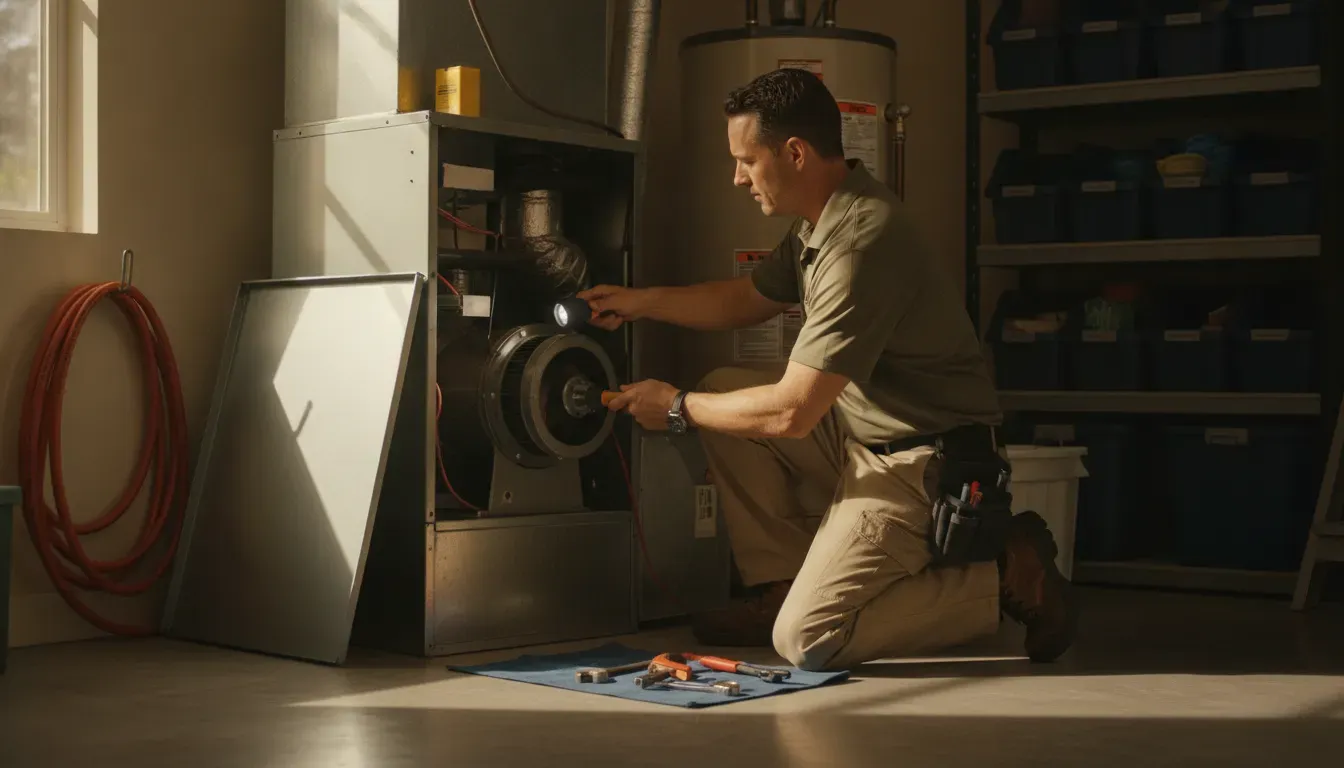
Airflow testing matters because a furnace can make heat without delivering it evenly. Duct restrictions, leakage, disconnected sections, and return-air problems can make a working furnace feel ineffective. Bay Care’s whole-home review can connect the furnace symptom with duct services, insulation, air sealing, or ventilation when those improvements are relevant.
How Can Maintenance Prevent Repeat Cold-Air Problems?
Professional maintenance can identify airflow, electrical, control, burner, heat exchanger, and venting concerns before heavy heating demand. ENERGY STAR recommends annual pre-season checkups and regular filter attention. Bay Care combines heating maintenance with a review of the home’s airflow and comfort pattern so recurring cold-air complaints are not treated as isolated symptoms.
The ENERGY STAR maintenance checklist recommends annual pre-season checkups, with heating equipment commonly scheduled before the heating season. Its heating guidance includes checking gas connections, burner combustion, heat exchanger condition, controls, and airflow-related components. Those tasks are for a qualified contractor, not a homeowner working inside the furnace cabinet.
At home, follow the filter instructions for your system and inspect the filter regularly. Keep supply registers and return grilles clear. Do not store combustible materials around a furnace, and keep the equipment area accessible for service. If the home has a carbon monoxide alarm, test it according to the manufacturer’s instructions and replace batteries or the alarm when required.
Maintenance cannot prevent every failure, and it does not make an unsafe furnace safe without repair. It can, however, give a technician a chance to identify developing airflow, electrical, combustion, or control concerns before the system is under its heaviest winter load. Bay Care’s heating maintenance service can help Delmarva homeowners plan that care.
If the furnace is older or repeatedly develops related problems, ask for an evaluation rather than assuming another reset will solve it. Bay Care can discuss heating installation options when replacement is appropriate.
Frequently Asked Questions
Why is my furnace blowing cold air but the fan is running?
The fan may be set to On, the furnace may be in a normal post-cycle period, or a safety control may have stopped heat production while the blower continues. Check the fan setting and accessible filter. If the air remains cold through a full heating call, schedule professional service.
How long should a furnace blow cold air when it starts?
A short period of cool airflow can occur while the system completes its startup sequence or clears cooler air from the ducts. There is no universal time for every furnace. If the air never becomes warm, the home temperature drops, or the equipment cycles repeatedly, call a technician.
Can a dirty filter make a furnace blow cold air?
Yes. A heavily loaded filter can reduce airflow and contribute to overheating, which may trigger a safety limit and shut off the heat while the blower continues. Replace an accessible filter with the correct type and size. If the symptom continues, have the furnace and airflow professionally checked.
Should I reset my furnace if it is blowing cold air?
Do not repeatedly reset a furnace to force it to run. A single normal user-control check may be appropriate when the manual permits it, but repeated shutdowns can indicate a fault. Stop and call for service if the equipment trips a breaker, smells unusual, shows a fault code, or fails to heat.
Is it safe to clean a furnace flame sensor myself?
Flame-sensor work requires opening the furnace and handling a combustion system, so it is not a recommended homeowner repair. A dirty sensor may not be the actual cause, and the system may have a different ignition or safety problem. Have a qualified technician test and service the furnace.
When is a furnace blowing cold air an emergency?
Treat gas odor, smoke, a strong burning smell, a carbon monoxide alarm, or symptoms that could indicate CO exposure as an emergency. Leave immediately, call emergency services from outside, and do not re-enter until responders say it is safe. Do not operate the furnace again until it has been evaluated.