Planning a new heating system raises two practical questions: how much will it cost, and what should installation include? The answer depends on the furnace, the condition of the venting and ductwork, the size and layout of the home, site access, and the safety work required. This guide to gas furnace cost and installation helps Delmarva homeowners compare proposals and prepare for a useful conversation with a professional.
Schedule a gas furnace consultation
What affects gas furnace cost and installation?
Bay Care treats gas furnace cost and installation as a whole-home decision. The equipment matters, but so do heat loss, airflow, duct condition, venting, combustion safety, electrical connections, thermostat controls, permits, and the home’s comfort goals. An evaluation can show which items are required, which are recommended, and which are not needed for your project.
There is no responsible one-price answer for every home. A replacement that uses existing, compatible connections may have a different scope from an installation that requires new venting, duct changes, gas-line work, drainage, or air-sealing improvements. A written proposal should explain those differences instead of presenting only a furnace model and a total.
Which parts of the project usually change the estimate?
- Furnace size and efficiency: A properly selected unit and its efficiency rating affect equipment choice and operating considerations.
- Existing equipment: Removal, disposal, and the condition of the current platform, flue, gas connection, and electrical service can change the work.
- Venting and combustion air: The installation must account for safe exhaust and adequate combustion air according to applicable requirements.
- Ductwork and airflow: Leaks, restrictions, undersized returns, or poorly balanced zones can limit comfort even after a new furnace is installed.
- Controls: A thermostat, zoning equipment, humidifier, or indoor air quality component may be compatible, incompatible, or unnecessary depending on the system.
- Access and preparation: Tight crawlspaces, attic access, condensate management, and protection for floors and walls can affect labor and scheduling.
For example, two homes may need the same general furnace capacity but still receive different estimates. One may have an accessible utility room and compatible venting. Another may need a duct transition, updated venting, condensate routing, or work to improve a return-air path. The difference is the project scope, not necessarily an attempt to sell a more expensive appliance.
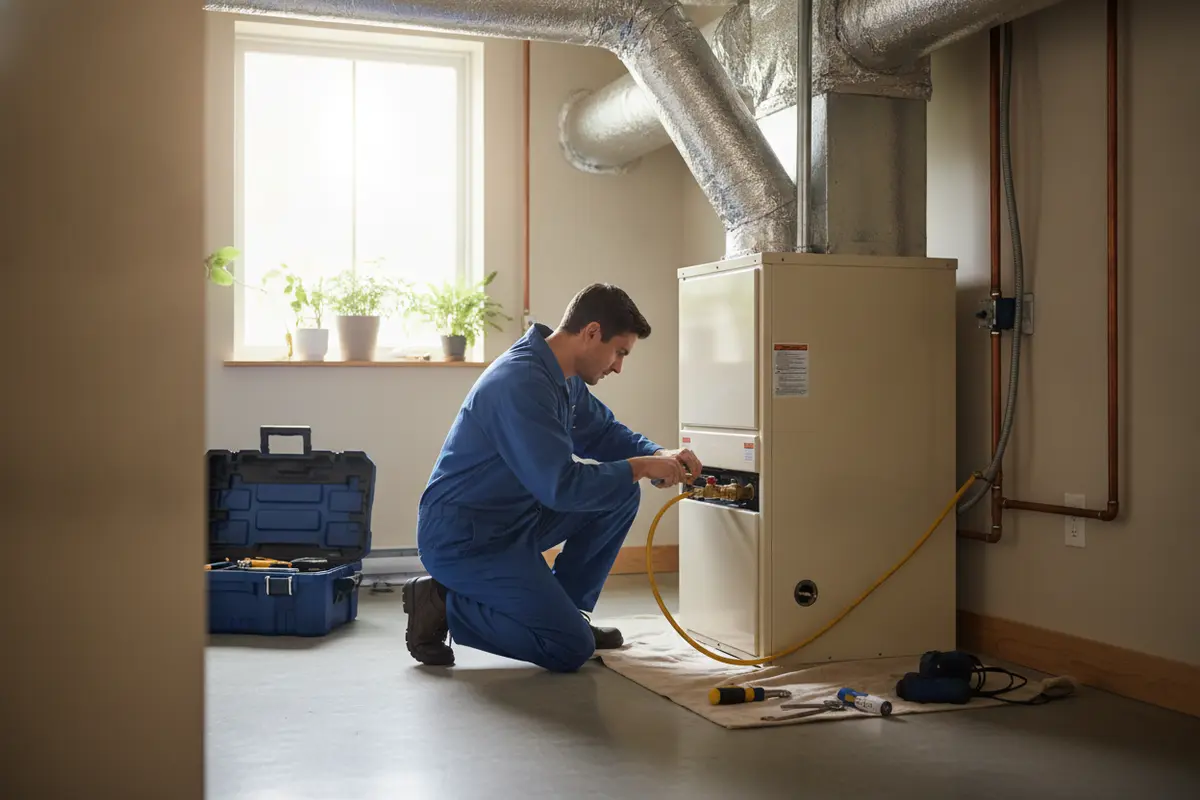
How much does a gas furnace installation cost?
Bay Care recommends using a project-specific estimate rather than relying on a national number. A published educational HVAC source describes standard HVAC replacement as a broad range that can include both a central air conditioner and a gas furnace, showing why a combined-system figure should not be treated as the price of a furnace alone. You can review that general discussion from the Refrigeration School, Inc. HVAC replacement overview, but your home’s scope remains the deciding factor.
For a useful comparison, ask whether each proposal includes the same categories of work. One quote may include only equipment and basic labor, while another may include permits, startup testing, disposal, thermostat work, duct corrections, or safety improvements. The lower initial number is not necessarily the lower-cost choice if important work has been left out.
Instead of asking only for a total, ask the contractor to separate equipment, labor, required modifications, optional improvements, taxes or fees when applicable, and any available incentives. This makes it easier to compare a straightforward replacement with a more involved project. It also gives you a written record of assumptions, such as whether the existing thermostat, flue, pad, and duct transitions can be reused.
| Cost factor | What to ask | Why it matters |
|---|---|---|
| Furnace equipment | What capacity, efficiency, fuel type, and warranty apply? | The model must match the home’s heating load and system design. |
| Removal and installation | Does the scope include removal, disposal, leveling, connections, and startup? | Excluded preparation can become an unexpected change order. |
| Venting and safety | Will venting, combustion air, gas connections, and safety checks be evaluated? | Combustion equipment requires careful installation and verification. |
| Ductwork and airflow | Are leaks, restrictions, returns, and supply balance included in the evaluation? | A new furnace cannot correct every duct or building-envelope problem. |
| Controls and accessories | Are thermostat, zoning, humidification, filtration, or other accessories optional? | You can separate comfort priorities from items you do not need. |
| Permits and closeout | Who handles permits, inspections, documentation, and homeowner instructions? | Clear responsibility helps the project finish properly. |
What should a gas furnace installation include?
Bay Care’s gas furnace installation process should be clear from evaluation through startup. The exact scope depends on the home, but a professional plan normally addresses equipment selection, removal of the old unit when applicable, connection work, venting, airflow, controls, testing, and homeowner orientation. A whole-home review can also consider insulation, air sealing, ventilation, and indoor air quality.
- Review the home and current system. Discuss comfort complaints, room temperatures, fuel use, maintenance history, and the age and condition of existing equipment.
- Confirm sizing and layout. The furnace should be selected for the home’s heating needs and connected to ductwork that can move the required air.
- Check fuel, electrical, and venting conditions. The installer should identify compatibility questions before equipment is ordered.
- Plan the installation. Confirm equipment location, access, condensate handling where applicable, thermostat controls, protection for the home, and disposal.
- Install and connect the equipment. Connections, duct transitions, venting, and controls should follow equipment instructions and applicable requirements.
- Test operation and explain the system. Startup should include operational checks and instructions for the homeowner.
Before approving the work, ask what the crew will protect, what happens to the old furnace, how long the home may be without heat, and what documents you will receive. These questions are especially useful when the furnace is in a finished basement, attic, crawlspace, or a narrow utility closet where access changes the installation plan.
Bay Care can also help homeowners compare a furnace replacement with broader heating installation options. If the existing system is still sound, a repair or maintenance plan may be more appropriate than replacement.
Does furnace efficiency change the value of installation?
Efficiency is one part of the value calculation, not the only part. Bay Care helps homeowners weigh equipment performance against installation scope, expected use, comfort problems, maintenance needs, sound, and the condition of the rest of the home. A more efficient furnace may not solve uneven rooms if duct leakage, insulation gaps, or airflow restrictions are the larger problem.
Ask the installer to explain the practical difference between equipment choices. Discuss the expected operating pattern, controls, maintenance requirements, sound, available fuel, and whether the unit will work well with the existing air conditioner. These details can matter more than choosing a rating without understanding the complete system.
For homes with persistent cold rooms or high heating demand, an energy evaluation can provide useful context before equipment selection. Bay Care’s energy audit service can be part of a broader review of insulation, air sealing, airflow, and comfort. That approach helps separate a furnace problem from a building-performance problem.
How do ductwork and the home affect gas furnace cost?
Bay Care evaluates the furnace as one component of the home. Duct leaks, poor returns, blocked registers, attic heat loss, insufficient insulation, and air leakage can all affect how the system feels and operates. Addressing those conditions may be more useful than simply installing a larger furnace, and oversizing can create its own comfort and cycling concerns.
During planning, ask whether the proposal includes an airflow review and whether recommended duct work is required for safe, reliable operation or offered as an optional comfort improvement. Bay Care provides duct sealing and attic insulation when an evaluation shows those services are relevant.
Consider a worked example: if bedrooms are cold while the furnace runs normally, the cause may be a restricted return, a disconnected duct, or heat loss in the attic. Replacing the furnace without checking those conditions could leave the original complaint unresolved. A whole-home review lets the proposal connect each recommendation to a specific symptom.
Indoor air quality is another consideration. A filter, humidifier, ventilation strategy, or other measure should be selected for the system and the household’s needs. Bay Care’s indoor air quality services can be discussed alongside furnace planning rather than added without a clear purpose.

What safety questions should you ask before installation?
Gas furnace work deserves careful attention to combustion, exhaust, fuel connections, electrical service, and carbon monoxide risk. Bay Care can explain which safety checks apply to the home and how the new equipment will be tested. Never bypass a safety control, adjust a gas connection yourself, or continue operating equipment that shows signs of unsafe combustion.
- Will the existing venting be inspected for compatibility and condition?
- Will combustion air and the equipment location be reviewed?
- Will gas connections, electrical connections, and safety controls be checked?
- Will the system be tested after startup, and will results be explained?
- What symptoms require the homeowner to shut down the equipment and call for help?
If you smell gas, leave the building and follow the instructions of your gas utility or emergency services. For a furnace that is not heating, Bay Care’s heating repair team can help determine whether repair, replacement, or a safety response is appropriate.
Combustion safety is not a detail to trade away for a lower bid. Ask how the installer will verify operation after the equipment is connected and how the results will be communicated. A clear answer helps you understand the difference between installing a box and completing a heating system responsibly.
Can rebates or financing reduce the upfront burden?
Some homeowners may qualify for financing or utility incentives, but eligibility depends on the equipment, location, program rules, and approval. Bay Care notes that qualified buyers may have access to 0% APR for 60 months on eligible Bryant systems, and eligible Maryland Delmarva Power customers may be able to explore rebates of up to $15,000 through applicable programs. These offers are program-dependent and should be confirmed before making a decision.
Review the current details on Bay Care’s rebates page and ask which documentation, deadlines, inspections, or equipment requirements apply. Do not assume that an incentive is available until eligibility is verified. Compare the full project cost, payment terms, expected comfort, and operating considerations together.
A rebate should be treated as a possible part of the plan, not as a reason to select equipment that does not suit the home. Ask whether the paperwork must be submitted before installation, which party supplies documentation, and whether the incentive changes if you combine a furnace with another upgrade. Confirm the answer in writing before relying on it in your budget.
How should you compare gas furnace installation proposals?
Bay Care encourages homeowners to compare scope before comparing totals. A strong proposal should make the equipment, work, assumptions, and next steps understandable. If two proposals differ, ask the contractors to explain the difference in plain language rather than choosing from a single number.
- Confirm the furnace model, capacity, efficiency, and warranty.
- Ask whether removal, disposal, permits, inspections, and startup are included.
- Check how venting, gas, electrical, condensate, and duct connections will be handled.
- Separate required work from optional comfort or indoor air quality improvements.
- Ask what happens if concealed conditions are discovered and how changes are approved.
- Confirm maintenance recommendations, homeowner responsibilities, and who to contact after installation.
It can also help to review Bay Care’s heating FAQ before the appointment. Bring the current furnace information, recent repair history, utility concerns, comfort complaints, and a list of rooms that do not heat evenly.
Use the same questions with every contractor. For instance, ask each one to identify required work, optional work, assumptions about existing connections, and the process for approving a change. A comparison based on matching categories is more useful than a comparison based only on the first number you see.
Frequently asked questions about gas furnace cost and installation
Bay Care can use your home’s existing conditions and your comfort goals to make these general answers specific to the project. A consultation is the best way to identify the actual scope and available options.
Is a gas furnace cheaper to install than a complete HVAC system?
It may be, because a furnace-only project does not necessarily include a new outdoor air conditioner. The actual comparison depends on compatibility, ductwork, venting, controls, and whether other equipment also needs replacement.
Can my existing ductwork be reused?
Sometimes. An installer should evaluate duct size, leakage, insulation, returns, transitions, and airflow before confirming that reuse is appropriate. Reusing ducts is not the same as assuming they need no attention.
Should I repair my furnace or replace it?
Consider age, repair history, safety, reliability, comfort, parts availability, and the cost and scope of the repair. A professional evaluation can compare a repair with a replacement without assuming that either option is right in every home.
How long does gas furnace installation take?
The schedule depends on the equipment and the work required. A straightforward replacement may differ from a project involving venting, duct corrections, permits, or other whole-home improvements. Ask for the expected schedule after the site review.
Can a new furnace fix uneven temperatures?
It may help if the current furnace is undersized or failing, but uneven temperatures can also come from ducts, insulation, air leakage, registers, or controls. A whole-home evaluation helps identify the cause before equipment is selected.
What should I bring to a furnace consultation?
Bring recent utility concerns, repair invoices or maintenance records, the furnace model information if available, and a list of rooms that feel too cold or too warm. Bay Care can use those details with the site evaluation to discuss priorities and possible next steps.
Call Bay Care at 302-245-3365 to compare your options
When you are ready to plan gas furnace cost and installation, Bay Care Heating & Air can evaluate the equipment, the home, and the comfort problem together so you can make an informed next step.