
If one room in your older Delmarva home is always too warm or too cool, the thermostat may not be the only place to look. HVAC duct insulation can help limit unwanted heat transfer as conditioned air travels through ducts, especially when those ducts run through an unconditioned attic, crawlspace, garage, or other space outside the home. Bay Care Heating & Air looks at ductwork as part of the larger comfort system, because insulation, airflow, duct condition, and equipment all affect how a home feels.
Request a ductwork and comfort assessment
How can HVAC duct insulation improve comfort in an older home?
Bay Care helps Delmarva homeowners consider where ducts run and what condition they are in before deciding whether insulation is likely to help. Insulation slows heat transfer between the air inside a duct and the surrounding space; it does not create heating or cooling, fix a leak, or correct a poorly balanced system. Its value depends on the duct location, existing insulation, air leakage, and the comfort problem you are trying to solve.
During cooling season, air traveling through a hot attic can warm before it reaches a room if the duct is poorly insulated. In heating season, warm supply air can lose heat as it passes through a cold area. Better insulated ducts can reduce that temperature change, helping more of the air arrive closer to the temperature the system produced. This is most relevant when duct runs pass through spaces that are not heated or cooled like the living area.
That does not mean every uncomfortable room needs more duct insulation. The room may be receiving too little airflow because of a disconnected, crushed, leaking, or poorly balanced duct. The equipment may also need service, or heat may be escaping through the home’s walls, windows, ceiling, or attic. A useful diagnosis follows the path from the HVAC equipment through the duct system to the room, rather than assuming one material is the answer.
For example, suppose a second-floor bedroom is warm on summer afternoons, while nearby rooms cool normally. If its supply duct crosses a hot attic, damaged insulation may contribute to the temperature difference. But if airflow at the register is weak, a restriction or leak may be more important. If airflow is steady and the room still gains heat quickly, windows, roof exposure, and insulation in the room’s enclosure may be part of the picture. The symptom identifies where to investigate; it does not establish the cause.
Where does duct insulation matter most in a Delmarva home?
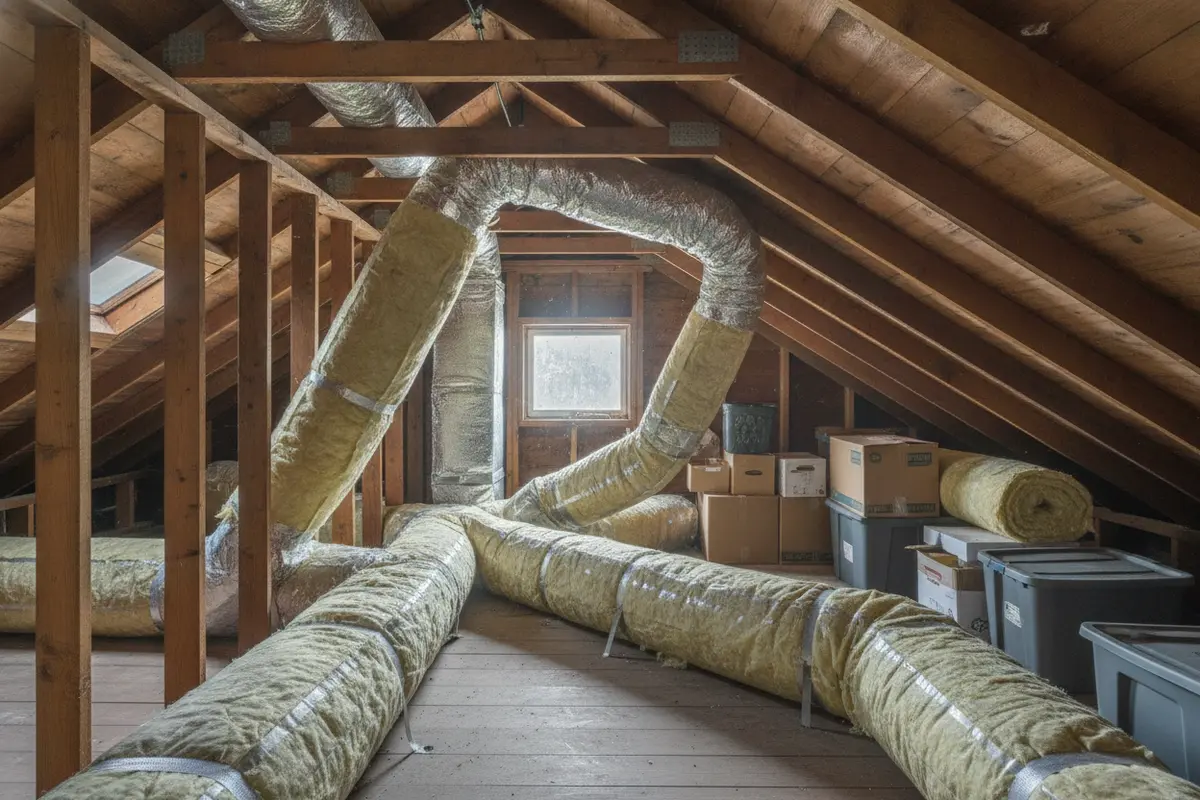
Bay Care considers the route and surroundings of the ductwork when discussing insulation options with local homeowners. Ducts located inside the conditioned part of the home are exposed to temperatures closer to the rooms they serve. Ducts in an attic, crawlspace, garage, or other unconditioned area face a larger difference between the air they carry and the surrounding air, so insulation can be more consequential there.
- Attics: Supply ducts crossing an attic can gain heat during summer and lose heat during winter. Look for insulation that is displaced, torn, compressed, missing, or visibly separated at joints.
- Crawlspaces: Ducts beneath a home may be exposed to colder conditions in winter and dampness or debris. Check for damaged insulation, loose sections, and signs that the duct itself is compromised.
- Garages and additions: Duct runs through these spaces may cross different temperature zones than the rooms they serve. An addition can also have duct routing or airflow limitations that insulation alone cannot solve.
- Interior chases: A duct enclosed within the home’s conditioned space may have less need for additional insulation, depending on its construction and location.
On the Delmarva Peninsula, a home may have a mix of duct locations and ages. One branch could run through an attic while another travels through an interior ceiling. Assess each section instead of assuming that one insulation recommendation applies everywhere. Bay Care’s Delmarva service areas include communities in Maryland and Delaware, where local homes may have different layouts and exposure conditions.
Also note which ducts carry supply air and which form part of the return path. Both are components of the air-distribution system, but their function and surroundings can differ. A return leak can draw air from an attic or crawlspace instead of the intended living area. That is an air-path concern, not simply a question of adding insulation around the outside of a duct. A good review records the route and role of each accessible section.
How do you tell whether insulation, a duct leak, or airflow is the problem?
Bay Care recommends separating three issues that can look similar from the homeowner’s perspective: heat transfer through duct walls, air escaping through gaps, and insufficient airflow to a room. Each has a different remedy. Insulation slows heat transfer; duct sealing addresses leakage; and airflow work investigates restrictions, balancing, or equipment performance. A room that stays uncomfortable may involve more than one of these at the same time.
| What you notice or find | Possible issue | What an assessment should check |
|---|---|---|
| Duct surface is bare or insulation is damaged in an attic or crawlspace | Heat transfer through an exposed duct | Duct location, existing insulation condition, and whether the run serves a conditioned area |
| Dusty streaks near a joint, loose connection, or air you can feel escaping | Air leakage | Connections, seams, boots, and duct integrity; sealing may be needed before insulating |
| A room has weak airflow, even when the system runs | Restriction, disconnected duct, balancing issue, or equipment concern | Air delivery from the system, duct path, dampers, filter, and equipment operation |
| Temperature varies from room to room, with no obvious duct damage | Several possible causes, including insulation, airflow, or building-envelope conditions | Room-by-room comfort patterns and the whole heating and cooling system |
| Moisture appears on or around a cold duct in humid conditions | Possible condensation on a surface below the surrounding air’s dew point | Insulation continuity, surface conditions, moisture source, and duct air leakage |
These are clues, not a do-it-yourself diagnosis. A dusty streak, for example, can point to air movement at a joint, but a visual check does not show every leak or explain why a particular room is uncomfortable. Do not handle damaged material, enter an unsafe attic or crawlspace, or cover a duct before its condition and moisture concerns have been considered.
Bay Care offers duct sealing and duct repair as distinct parts of a broader ductwork discussion. If a system’s airflow is the concern, ask about the relevant residential HVAC services as well. The right next step depends on what the inspection finds, not just on a symptom such as a hot bedroom.
One practical way to organize observations is to compare rooms rather than relying on a general impression. Note whether a room is uncomfortable all day or only during a particular part of the day, whether the issue occurs in heating, cooling, or both seasons, and whether the register’s airflow feels different from nearby registers. Make a simple room list and mark any known duct route. This information gives an assessor a starting point without asking you to dismantle or test the system.
What should an HVAC duct insulation assessment include?
Bay Care’s whole-home approach connects ductwork with equipment, airflow, insulation, air sealing, and ventilation. A useful assessment should establish where the ducts are, what condition they are in, and how the home behaves in both heating and cooling conditions. Ask the technician to explain what was observed and how each recommended step relates to the problem you reported.
- Describe the comfort pattern. Note which rooms are affected, whether the issue appears during heating or cooling, and whether it changes with weather or time of day. Mention recent equipment or renovation work if relevant.
- Trace accessible duct routes. Identify which runs travel through an attic, crawlspace, garage, or interior space. The assessor should distinguish visible portions from areas that could not be accessed.
- Check insulation condition. Look for missing, loose, compressed, damaged, or discontinuous insulation. The right material and installation details depend on duct location and project conditions.
- Look for leakage and damage. Inspect accessible joints and connections, and note crushed, disconnected, or deteriorated sections. Sealing or repairing a duct can be a separate need from insulating it.
- Consider airflow and system operation. A comfort investigation may need to consider the filter, return and supply paths, balancing, and equipment operation, not only the insulation around a duct.
- Discuss moisture and condensation. If there are wet spots, staining, or condensation, find the contributing conditions before enclosing or covering the area. Insulation should not be used to hide an unresolved moisture problem.
- Review options in order. Ask which work addresses the main cause, what can be addressed separately, and what result is reasonable to expect. A clear recommendation distinguishes needed duct work from other home performance improvements.
Some ducts are concealed behind walls or ceilings, so an initial visual review may not reveal their full condition. Ask what is known, what remains uncertain, and whether additional access or testing is warranted before approving a larger scope.
Before the appointment, gather a few useful details. Write down the rooms that feel different and when you notice it. If you have recently changed a thermostat schedule, filter, or register setting, mention that too. A photo of visible insulation or a duct connection can help explain what caught your attention, as long as it can be taken without climbing, moving materials, or entering a hazardous space. Do not feel that you need to prepare a technical diagnosis.
During the review, ask for findings in terms you can compare: which runs were inspected, what condition they were in, what work is proposed, and what remains outside the scope. If the technician cannot see a section, ask how that limitation affects the recommendation. A transparent distinction between observed facts and assumptions makes it easier to decide whether a targeted repair or a broader investigation is appropriate.
Can insulation solve condensation on ductwork?
Bay Care treats condensation as a condition to investigate, not simply a cue to wrap a duct and move on. Moisture can form when a surface becomes cold enough relative to humid surrounding air. Insulation may help keep the outer surface warmer when the duct is carrying cold air, but gaps, damaged insulation, humid air, or another moisture source may also matter. The source and conditions need attention alongside any insulation decision.
Check whether condensation is limited to one section or appears at joints, supports, or multiple surfaces. Note whether it occurs during cooling operation or after a change in weather. Do not seal wet material inside a new covering; trapped moisture can create additional problems. If moisture is recurring, staining is spreading, or you see damaged material, have the area evaluated before attempting a repair.
The U.S. Environmental Protection Agency describes duct board and duct liner as materials used in duct systems for thermal, acoustic, and condensation-control properties. That general information does not establish that a particular product or repair is right for every home. The condition of the duct, the setting, and proper installation all matter. See the EPA’s discussion of HVAC systems and duct materials for more context.
When describing moisture to a professional, distinguish condensation on the duct’s exterior from a plumbing or roof leak, water intrusion, or dampness in the surrounding space. The source may not be obvious from a quick glance. Record where moisture appears and whether it returns after drying, but avoid touching wet electrical components or disturbing insulation. Addressing the source is important; covering visible moisture can conceal rather than solve the condition.
Should you insulate ducts yourself or hire an HVAC professional?
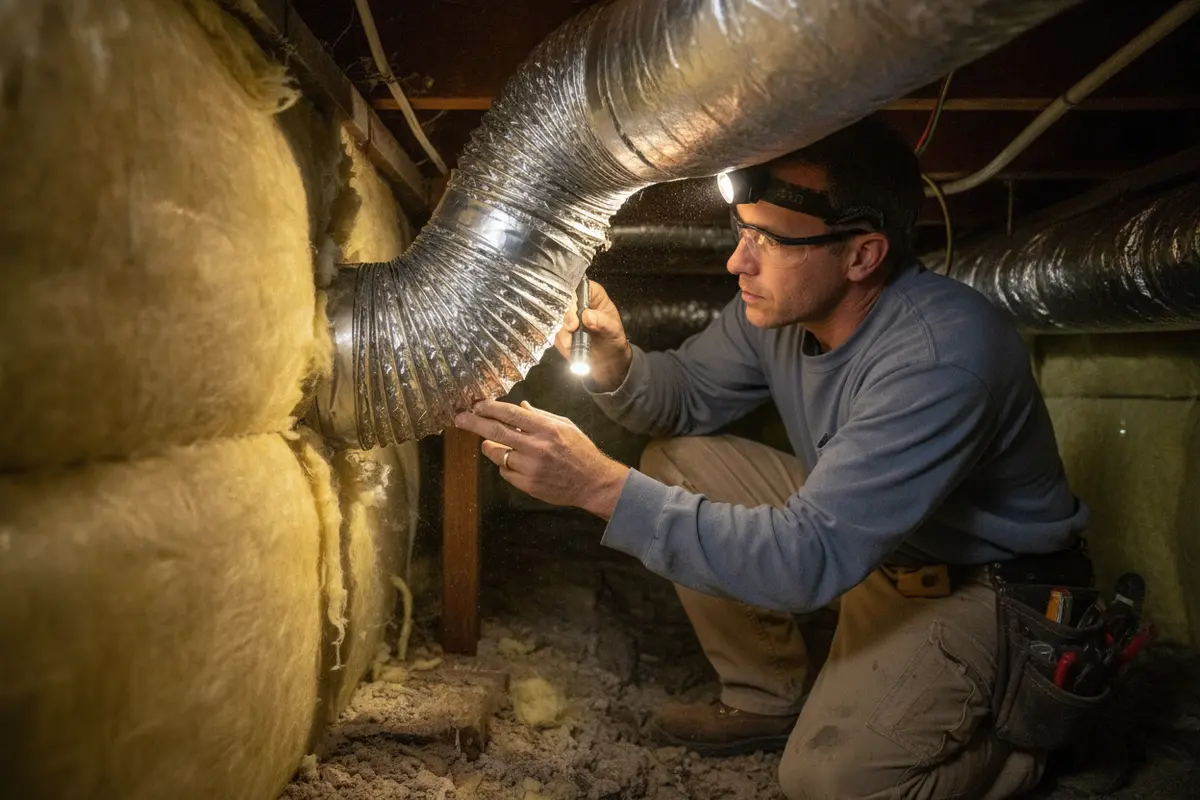
Bay Care encourages homeowners to observe and document accessible concerns, while leaving uncertain or difficult duct work to a qualified professional. You can take photos from a safe, stable location and note where ducts appear bare or damaged. But working in an attic or crawlspace can involve fall risks, electrical hazards, extreme temperatures, pests, and materials that should not be disturbed. Do not climb onto ductwork or pull apart insulation to inspect hidden surfaces.
Professional input is especially useful when ducts are hard to reach, the insulation is wet or damaged, there is a persistent airflow problem, or condensation keeps returning. Correct installation depends on the duct’s location and condition. A recommendation should also clarify whether sealing or repair needs to happen before additional insulation is installed.
For related home-performance concerns, Bay Care can also discuss energy audits, which look more broadly at how a home’s systems and envelope work together. If the question extends beyond the duct system, indoor air quality services may be relevant to discuss, too. These are related topics, but they are not automatic solutions for a duct insulation issue.
A homeowner can still do useful preparation without doing the installation. Keep a short log for a few days: room, time, outdoor conditions if known, system mode, and what you noticed at the register. Avoid changing several settings at once, because that can make it harder to identify what changed. This is not a substitute for an inspection, but it can help describe a repeatable pattern instead of relying on memory during a brief appointment.
How should you compare duct insulation recommendations?
Bay Care suggests comparing recommendations by the problem they address rather than by a material name alone. Ask for a description of the duct locations involved, current condition, proposed work, and any separate sealing or repair. Because home layouts and access differ, avoid relying on an unexplained blanket recommendation or a promise that insulation alone will fix every uneven room.
- Ask for location-specific findings. Which duct sections are exposed to unconditioned space? What was actually inspected?
- Separate the work types. Is the proposal for insulation, air sealing, repair, or a combination? What issue does each item address?
- Clarify preparation. Does the duct need cleaning, repair, drying, or sealing first? How will moisture concerns be handled?
- Discuss access and limitations. Are any sections concealed or inaccessible? Is additional investigation needed?
- Set a practical expectation. What comfort change is plausible, and what other causes could remain? Insulation can reduce heat transfer but cannot guarantee a specific room temperature.
A detailed scope lets you make an informed decision and helps avoid paying to cover a symptom without addressing its cause. If the proposed work also involves a heating or cooling upgrade, compare that decision separately. Bay Care’s residential services include HVAC and home performance options, and the company’s whole-home approach considers how those pieces interact.
It can help to request a recommendation broken into phases if the inspection identifies multiple concerns. For instance, the immediate priority might be reconnecting a damaged section, while insulation improvements are considered for a separate exposed run. Another home may need investigation of airflow before any insulation work is planned. Ask which steps depend on one another, which can be evaluated independently, and what observations would show that the original comfort concern needs further attention.
Compare proposals on scope and access, not just on the amount of material listed. One recommendation may cover only visible accessible runs; another may include repairs or treatment of joints. Ask whether removal of failed insulation, surface preparation, disposal, and restoration are included where relevant. The purpose is not to prescribe a particular installation method from a checklist, but to understand what each scope covers and which parts of the home it leaves unchanged.
What changes should you expect after duct insulation work?
Bay Care encourages realistic expectations: insulation can limit heat transfer through a duct, but the result depends on where that duct runs and whether other problems remain. After work, compare the same rooms under similar operating conditions rather than judging the result from one unusually hot or cold day. Changes in airflow, room temperature, and system run patterns can help guide any follow-up conversation, but they do not prove that insulation was the only factor.
Before work begins, agree on what concern the project is meant to address. If the complaint was a warm bedroom, record when it happens and how it compares with nearby rooms. Afterward, note whether the pattern changes in the same conditions. If the room remains uncomfortable, report that fact instead of assuming the work failed or that more insulation is automatically needed. The next step may be a separate airflow, equipment, or building-envelope investigation.
Also distinguish comfort from energy use. Better insulated ducts can reduce unwanted heat exchange in appropriate locations, but household energy use reflects many factors: weather, thermostat settings, equipment condition, air leakage, and how often the system runs. Avoid treating a short bill comparison as a guarantee or a definitive measure of the insulation’s effect. A qualified assessment can explain the likely role of duct work within the home’s broader performance.
When should you contact Bay Care about duct insulation?
Contact Bay Care if you have exposed or damaged duct insulation, recurring condensation, persistent uneven temperatures, or uncertainty about whether a duct needs insulation, sealing, repair, or airflow work. Share which rooms are affected and where the ductwork is located, if you know. Bay Care serves homeowners across Maryland and Delaware on the Delmarva Peninsula and can help discuss the appropriate next step.
If you are unsure whether a visible concern is urgent, describe what you see without attempting to remove a covering or manipulate a connection. Mention any persistent moisture, noticeable airflow change, or recent work on the HVAC system. A clear description helps the conversation start with the actual symptom and keeps the recommendation focused on the part of the system that needs attention.
Talk with Bay Care about your ductwork
Frequently Asked Questions
Does duct insulation help with a hot upstairs room?
It may help if ducts serving the room pass through a hot attic and are poorly insulated, but a hot room can also result from limited airflow, duct leakage, system balance, or heat entering through the building envelope. An assessment should identify the likely cause before insulation is recommended.
Should ducts inside my home be insulated?
Not necessarily. Ducts within conditioned space are surrounded by air closer to the temperature of the rooms, so their insulation needs may differ from ducts in an attic or crawlspace. The location, duct design, and project requirements determine what is appropriate.
Can I put new insulation over old duct insulation?
Do not cover damaged or wet material without understanding its condition and the cause of the damage. An HVAC professional can check whether the duct needs repair, sealing, drying, or removal of deteriorated material before new insulation is considered.
Does duct insulation stop air leaks?
No. Insulation slows heat transfer through duct walls. Sealing is intended to address air escaping at joints or openings, while repair addresses damaged or disconnected sections. The work may be combined when inspection shows multiple issues, but one does not replace the other.
Will insulating ducts lower my energy bills?
Insulation can reduce unwanted heat transfer on duct runs in unconditioned spaces, but the actual effect depends on the home, duct condition, system use, and other factors. No particular savings should be assumed without evaluating the specific situation.
What information should I have ready when I ask for help?
Describe the affected rooms, whether the issue occurs during heating or cooling, and any visible duct damage, bare insulation, or recurring moisture. Photos taken from a safe place can help explain what you noticed. You do not need to enter an unsafe space or disturb duct materials.
HVAC duct insulation can be a practical comfort measure when duct location and condition call for it, but it is only one part of a working HVAC system. A careful look at insulation, leakage, airflow, moisture, and the home’s overall comfort pattern helps you choose the right fix for your Delmarva home.


