
If one room stays stuffy while another feels comfortable, or the HVAC system seems to run without moving enough air, the ductwork may deserve attention. HVAC duct repair can address disconnected joints, crushed sections, leaks, and other physical problems. The right fix starts by identifying the cause rather than guessing from one symptom.
Request help evaluating your ductwork
Bay Care Heating & Air serves homeowners and businesses across the Delmarva Peninsula. This guide explains which clues to look for, what you can safely check, what a professional inspection may cover, and how to think about repair options. Duct problems are one part of a whole-home comfort system, alongside equipment, airflow, insulation, air sealing, and ventilation.
What are the signs that HVAC ducts need repair?
Bay Care recommends looking for patterns rather than treating one uncomfortable day as proof of a duct defect. Persistent weak airflow, rooms that respond differently from the rest of the home, visible duct damage, and unusual dust near a supply register can all justify a closer look. These clues point to questions to investigate; they do not confirm a specific repair by themselves.
- One or more rooms repeatedly feel different. A closed or poorly adjusted register, a door-related pressure issue, insulation, sun exposure, or duct routing can all affect comfort. A recurring difference is more useful to report than a single temperature reading.
- Airflow seems weak at particular registers. Compare similar registers while the system is running. If only one area has a change, tell the technician which rooms and whether the issue affects heating, cooling, or both.
- You notice visible damage. A duct that is crushed, separated, hanging loose, or visibly torn merits inspection. Do not climb over unstable framing or disturb insulation to get a better view.
- Dust, odors, or noise appear near a duct opening. These signs can have several causes. A dirty filter, household activity, equipment condition, or a duct leak may be involved, so avoid assuming that cleaning or repair is automatically the answer.
- Comfort changed after work in an attic, crawlspace, or ceiling. Construction, storage, pests, or other activity can shift or damage accessible ductwork. Mention any recent work when arranging an evaluation.
Keep a short record for several days: the affected rooms, system mode, thermostat setting, approximate time, and whether doors were open or closed. This context helps separate a persistent distribution problem from changing weather or normal room-to-room differences.
Could another home comfort problem look like duct damage?
Bay Care takes a whole-home view because airflow complaints are not automatically duct failures. A clogged filter, blocked register, equipment issue, leaky building envelope, or inadequate insulation can create similar symptoms. Identifying where the problem begins helps avoid paying for a repair that does not address the reason a room feels uncomfortable.
Before scheduling, do a few low-risk observations. Check that supply registers and return grilles are not covered by furniture, rugs, or curtains. Confirm that the air filter is installed in the correct direction and is due for replacement according to its instructions. Note whether the concern is new, seasonal, or present in both heating and cooling seasons.
Do not close many registers to force air into other rooms. That can alter system airflow and may create other performance problems. Likewise, do not push objects into a grille or attempt to reach hidden ducts. If a register is loose or a grille is visibly blocked, you can address that simple obstruction, then observe whether the same room still has an issue.
Building conditions matter, too. A room over a garage, an attic bedroom, or a space with large sun-facing windows may gain or lose heat differently. A door that stays shut can change air movement in some layouts. Bay Care can consider duct condition alongside attic insulation, duct sealing, and broader home performance factors rather than treating every comfort complaint as an equipment failure.
What can you safely check before calling for HVAC duct repair?
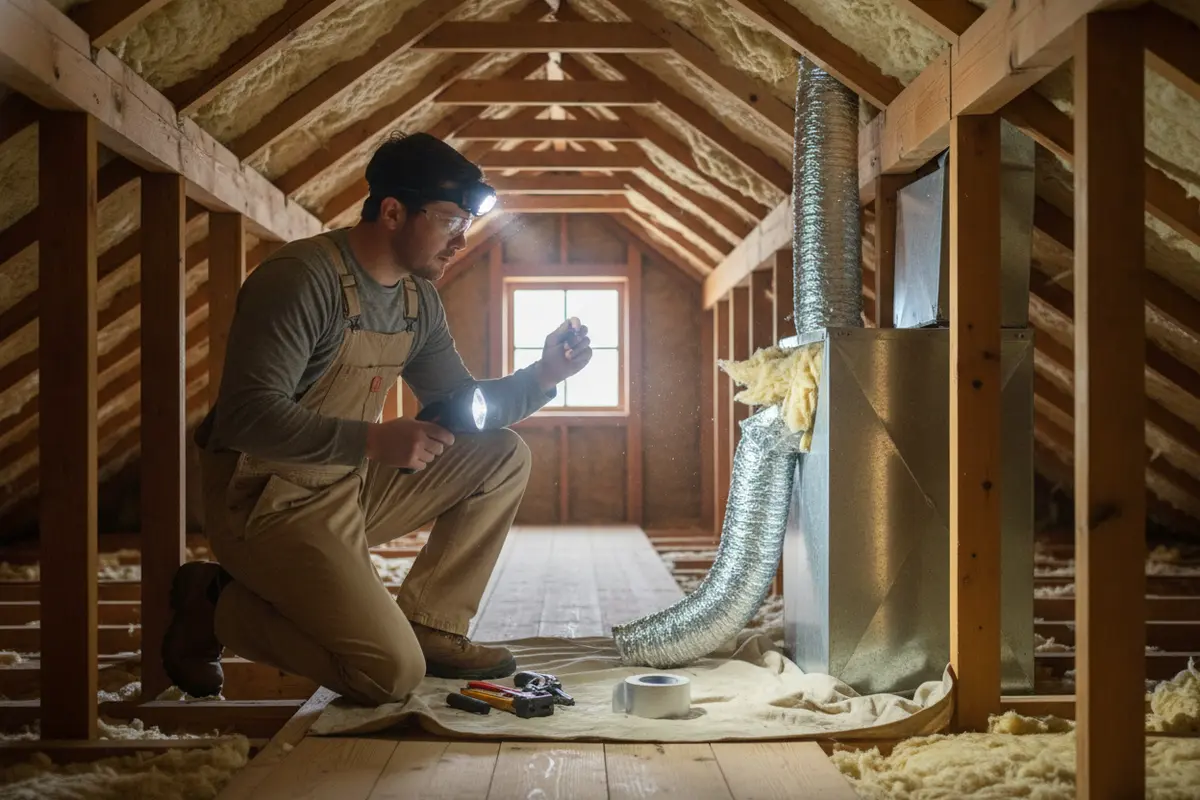
Bay Care suggests a brief, visual-only check of accessible areas, followed by a clear description of the symptoms. Homeowners can inspect a visible duct from a safe floor or walkway and look for obvious separation, sagging, or crushing. Leave confined, elevated, hot, or poorly lit spaces to a qualified professional, and never handle wiring, mechanical equipment, or suspected hazardous materials.
- Write down the affected rooms. Identify where the issue occurs and whether nearby rooms are comfortable. Note if it is limited to a particular floor or side of the home.
- Check registers and returns. Make sure they are open and not blocked by objects. Do not remove components that appear fastened or part of the duct system.
- Observe accessible ductwork only. From a stable, safe location, look for a separated connection, a sharply flattened section, a loose support, or visible damage. A photograph from a safe distance may help explain what you saw.
- Record the system conditions. Note whether the heating or cooling is on, whether the system runs continuously or cycles, and whether the airflow changed recently. Avoid repeatedly changing thermostat settings to test the system.
- Share recent changes. Tell the technician about renovations, attic storage changes, pest activity, or prior work that could relate to the affected area.
Do not apply household tape, foam, or sealant to hidden ducts as a substitute for diagnosis. Duct materials and locations differ, and a patch on the visible surface may not correct a loose connection or a larger airflow issue. If you see water near equipment or ductwork, report it; do not assume the duct itself is the source.
How does a professional evaluate HVAC duct repair needs?
Bay Care can use the reported symptoms and an inspection to narrow down whether a duct repair is appropriate. The exact steps depend on access and the system. A useful evaluation should explain what was observed, where the problem is, why it could cause the reported comfort issue, and what work is proposed before you decide how to proceed.
An assessment may include checking accessible duct sections and connections, looking for constrictions or disconnections, and comparing the complaint with airflow at the affected registers. The technician may also consider the air filter, equipment operation, returns, and whether the home has conditions that can affect room comfort. Not every home or complaint calls for the same tests.
Ask the technician to distinguish confirmed findings from possibilities. For example, “the branch serving this room is disconnected at the visible joint” is a specific observation; “the ducts might be dirty” is not a repair diagnosis. Request a plain-language explanation of the location and condition, the recommended work, any access limitations, and whether a follow-up check is part of the proposed scope.
If the issue might involve system performance beyond the duct, Bay Care also offers home energy audits, blower door testing, and indoor air quality services. These are distinct services, not automatic steps in every duct-repair visit. Ask what is relevant to the symptoms you have described.
Which HVAC duct repair may fit the problem?
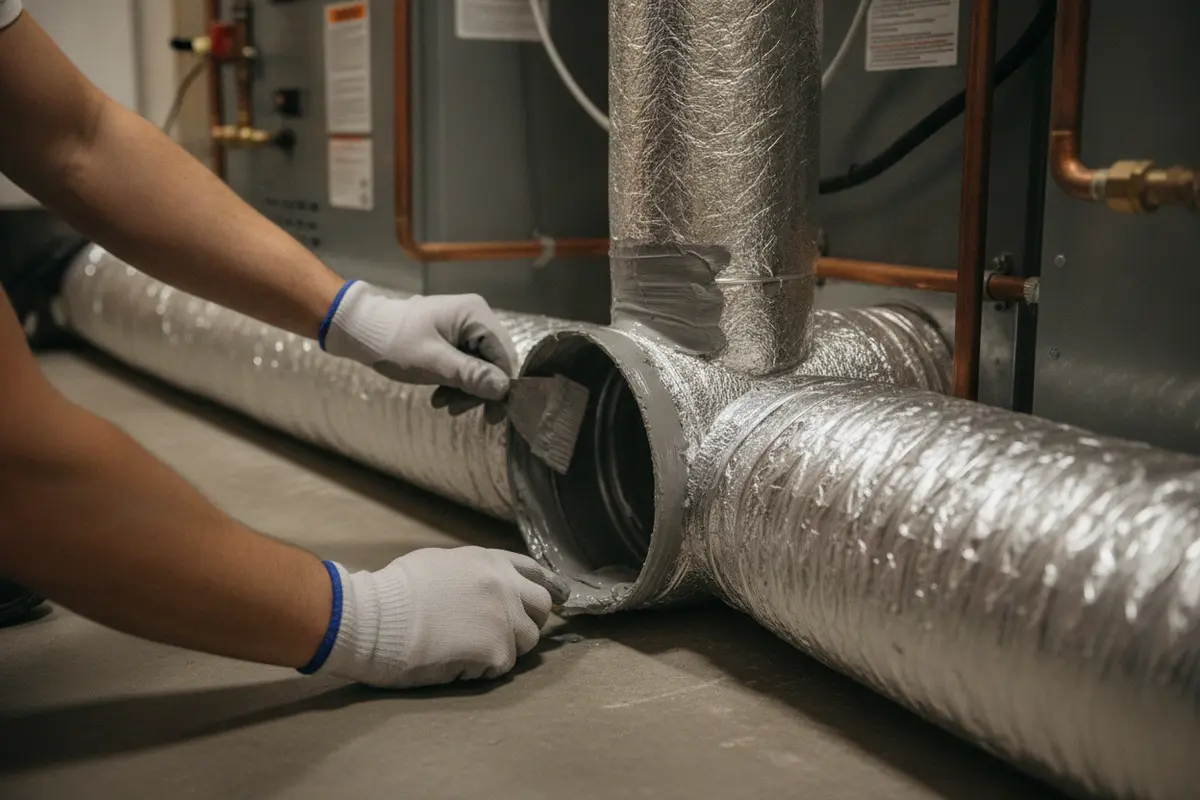
Bay Care matches the repair to the observed defect and the duct type, location, and accessibility. A separated joint may need reconnection and appropriate sealing; a crushed, torn, or deteriorated section may require correction or replacement. The table below is a discussion guide, not a diagnosis: the same symptom can come from more than one cause.
| Observed condition | Possible response | What to confirm |
|---|---|---|
| Accessible connection has pulled apart | Reconnect and secure the joint, then seal it with materials suited to the duct | Which rooms are served and whether the connection is now stable |
| Flexible duct is sharply crushed or kinked | Restore a suitable path and support, or replace the damaged section if needed | Whether the route or support is contributing to restricted airflow |
| Visible tear or deterioration | Repair or replace the affected area based on its condition and construction | How much material is affected and whether adjacent sections also need attention |
| Room airflow remains uneven without visible damage | Investigate other branches, registers, returns, equipment, or building conditions before selecting a fix | What inspection findings support any proposed work |
| Dust or debris is the main concern | Determine whether there is a specific contamination issue; do not presume a duct repair is needed | Whether the concern is cleaning, a physical defect, a filter issue, or another source |
The U.S. Environmental Protection Agency says studies do not conclusively show that dust levels in homes increase because of dirty air ducts. That statement is about duct cleaning and dust levels, not a reason to ignore a physically damaged or disconnected duct. The EPA describes circumstances where duct cleaning may be appropriate, such as substantial visible mold growth inside hard-surface ducts, vermin infestation, or ducts clogged with excessive dust and debris. See the agency’s guidance on whether to have air ducts cleaned and discuss the condition actually observed.
Repair and cleaning solve different problems. A detached connection needs attention to the connection; a cleaning service does not reconnect it. Conversely, dust at a register alone does not establish that a duct has a leak or needs replacement. Bay Care can explain the difference between duct repair, duct cleaning, and duct maintenance based on what is found.
When is a duct repair part of a larger whole-home issue?
Bay Care considers the building and HVAC system together when comfort remains uneven after a localized duct issue is addressed. Insulation, air leakage, ventilation, return-air paths, and equipment condition can interact with duct performance. If an inspection does not find a clear defect, or if symptoms remain after a repair, it can make sense to ask whether a wider assessment is warranted.
For example, a hot upstairs room may be affected by several factors at once: sun exposure, attic insulation, a supply branch, or the path that air takes back to the system. A drafty room may reflect air leakage through the building envelope rather than a supply-duct leak. The purpose of a whole-home approach is not to expand every repair; it is to identify which factor has evidence behind it and address that factor.
Bay Care serves the Delmarva Peninsula, including Maryland and Delaware communities. Homes near the coast may face additional equipment concerns from salt air, but corrosion protection is separate from duct repair. If your question involves an overall comfort or efficiency concern, learn about Bay Care’s residential services and service areas, then describe the specific rooms and symptoms when you reach out.
What should you ask before approving ductwork service?
Bay Care encourages homeowners to understand the proposed scope before work begins. A clear conversation can establish whether the recommendation addresses a confirmed duct defect, what parts of the system are accessible, and how the result will be checked. You do not need to identify the technical solution yourself; you can ask for a straightforward explanation of the observations and choices.
- Where is the problem, and what did the inspection show?
- Is the recommended work a repair, replacement of a section, cleaning, or a separate service?
- How does the finding relate to the rooms or airflow concern I reported?
- Are there access limits or related conditions that could affect the work?
- What materials or sections are included in the proposed scope, and what is not included?
- How will you check that the repair is secure and that the original concern has been addressed?
- If the symptom continues, what should I note or report next?
Ask for the recommendation and scope in language you understand before authorizing work. Avoid relying on a broad promise to “fix airflow” without knowing what specific condition was observed and what work is proposed. If a technician finds more than one issue, ask which item is necessary now and which is optional or should be evaluated separately.
Call Bay Care to discuss your duct concerns
Frequently Asked Questions
These answers can help you decide what information to gather before contacting Bay Care. The symptoms below are useful starting points, but an inspection is needed to identify the cause in an individual home.
Can a duct problem make one room feel warmer or colder?
It can contribute to uneven room comfort, especially if a branch is disconnected, restricted, or damaged. Insulation, sunlight, windows, doors, and equipment operation can also affect a room, so the symptom alone does not confirm duct damage.
Does dust around a vent mean I need HVAC duct repair?
No. Dust near a register can have several sources and does not by itself prove that a duct is damaged or needs cleaning. Look for a specific physical defect and ask a professional to distinguish a duct repair question from a cleaning or filtration concern.
Can I seal a duct leak myself?
A homeowner should avoid patching hidden or inaccessible ductwork without knowing its material and condition. You can note visible damage from a safe location, but a qualified technician can identify the appropriate repair materials and determine whether a loose connection or damaged section needs more than a surface patch.
Is duct cleaning the same as duct repair?
No. Cleaning targets debris or contamination in ductwork under appropriate circumstances. Repair addresses a physical defect such as a disconnected, crushed, or torn section. One service does not automatically replace the other, and neither should be recommended without a reason tied to the observed condition.
What should I tell an HVAC technician about airflow problems?
Share which rooms are affected, when the concern began, whether it occurs during heating or cooling, and any recent construction or changes near the ducts. Mention whether registers are blocked or visibly damaged. These details help focus the evaluation.
Does every uneven-temperature room need duct repair?
No. Air distribution is only one part of comfort. A technician may find that the issue involves a register, filter, equipment, insulation, air leakage, or another condition. The inspection should connect the proposed work to an observed cause.
Ready to talk through your duct repair options?
Persistent weak airflow, visible duct damage, or recurring room-to-room comfort differences are good reasons to ask questions. Bay Care Heating & Air can help you evaluate whether the issue calls for duct repair or a broader look at the home’s comfort system. Describe what you have noticed and where it occurs so the next step can be based on the actual concern.


