
Many Maryland homeowners expect an HVAC replacement to help with comfort, but the utility savings can be just as meaningful. Heating and cooling account for nearly half of a typical home’s energy use. So equipment efficiency, duct condition, insulation, and air leakage all influence what you pay each month.
Schedule your free HVAC upgrade consultation
HVAC upgrade energy savings can reach 20% or more when an older system is replaced with modern high-efficiency equipment. Savings may improve further when the upgrade is paired with duct sealing, air sealing, insulation, and eligible Delmarva Power rebates.
The exact result depends on your current system, home envelope, thermostat settings, and energy use. Bay Care looks at those factors together through a whole-home energy efficiency approach, rather than treating the equipment as an isolated expense. The first step is understanding what a modern heat pump can change on its own.
Average Energy Savings from a New High-Efficiency Heat Pump
Upgrading an older heating and cooling system to a modern high-efficiency heat pump can make a noticeable difference in a Maryland homeowner’s monthly utility costs. Trane reports that updating an older HVAC system to a modern, efficient unit could reduce energy bills by 20 percent or more. Your actual savings depend on the existing equipment, thermostat settings, home envelope, ductwork, and local utility rates, but the potential is significant.
Heating and cooling account for nearly half of the average home’s energy use, according to ENERGY STAR. That makes HVAC equipment one of the most important places to look when you want to reduce household energy consumption. A heat pump can provide both heating and cooling from one system. While modern components are designed to transfer heat more efficiently than many aging systems that run longer, cycle poorly, or lose capacity over time.
Why equipment age affects your utility bills
Modern heating and cooling systems can reach about 95 percent efficiency, compared with roughly 60 to 70 percent for older models, according to Trane. That gap does not guarantee a specific dollar amount, but it helps explain why an older system may consume substantially more energy to deliver the same indoor comfort. In Maryland’s coastal climate, where equipment handles humid summers and cold winter periods, dependable performance across both seasons matters.
Before choosing equipment, compare the expected operating costs with the heat pump installation cost in Maryland. A qualified evaluation should account for sizing, insulation, airflow, and duct condition rather than focusing only on the unit’s nameplate efficiency. Those details determine how much of the system’s rated performance reaches your living spaces and how quickly the upgrade may pay for itself.
How Duct Sealing and Insulation Multiply HVAC Efficiency Gains
A high-efficiency HVAC system can only perform as well as the home around it. If conditioned air escapes through leaky ductwork before it reaches the rooms, the equipment has to run longer to maintain the thermostat setting. ENERGY STAR explains that ducts leaking conditioned air into unconditioned areas, such as attics or crawlspaces. Can add to energy bills while homeowners are still paying to heat or cool that air.
This problem is especially important in Delmarva homes, where ductwork may pass through hot attics, vented crawlspaces, garages, or other spaces outside the home’s conditioned envelope. A new heat pump or air conditioner may have excellent efficiency ratings, but leakage and poor insulation can reduce the comfort and savings you experience at the registers.
Why duct sealing matters after an HVAC upgrade
Sealing accessible duct joints and connections helps keep more conditioned air in the intended delivery path. It can also reduce uneven temperatures, excessive run times, and the strain caused by trying to compensate for lost airflow. A professional evaluation should look beyond visible supply registers and identify disconnected sections, damaged insulation, loose fittings, and return-side leaks.
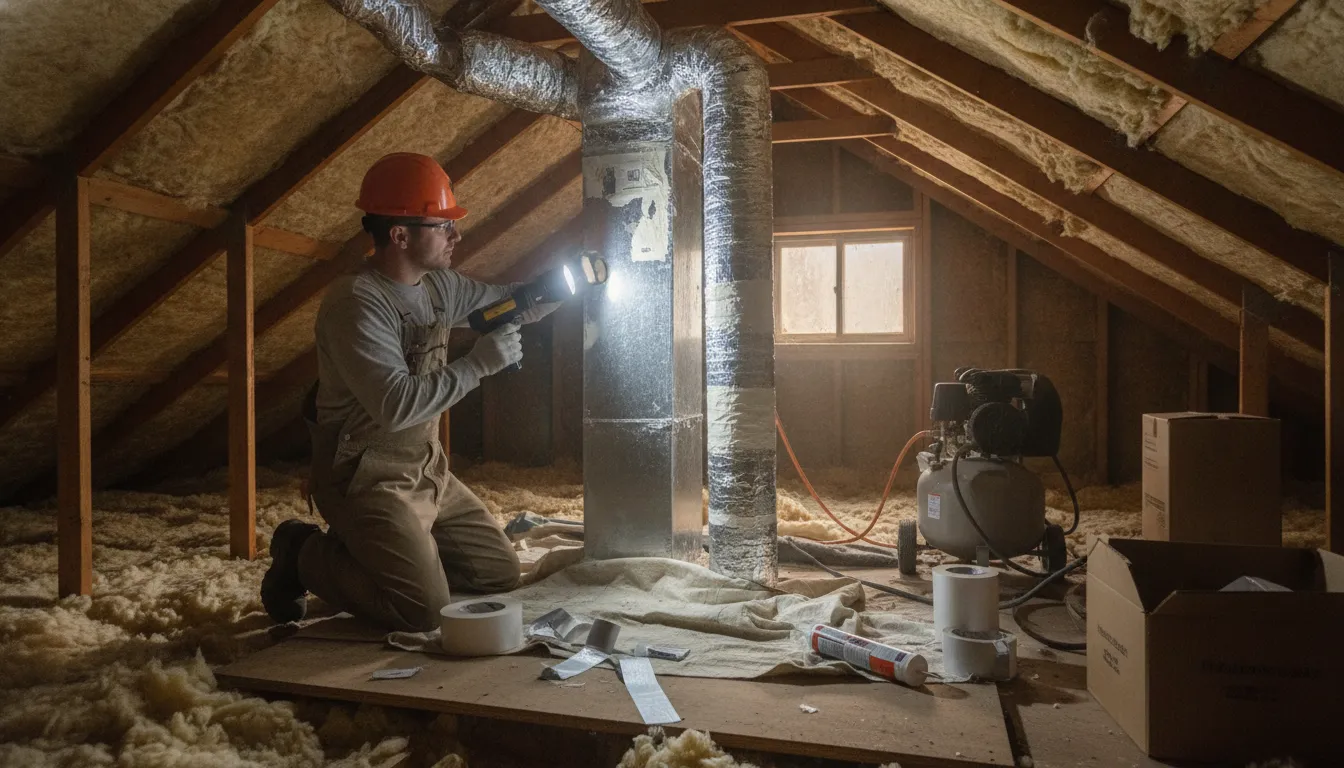
Read Bay Care’s guide to duct sealing to understand where common leakage occurs and what a thorough repair should address.
How insulation and air sealing complete the improvement
Insulation slows heat transfer, while air sealing limits uncontrolled drafts through gaps around attics, floors, walls, and penetrations. Together, these improvements help the home hold the temperature your HVAC system worked to create. That means fewer comfort swings and less demand on the equipment during Maryland’s humid summers and cold winter weather.
Bay Care’s whole-home approach combines insulation, air sealing, and HVAC improvements instead of treating equipment as an isolated fix. Addressing these connected systems can maximize comfort and support longer equipment life, allowing an HVAC upgrade to deliver more of its expected energy savings over time.
What a Whole-Home Approach Delivers vs. Equipment Swap Only
Replacing an aging furnace or air conditioner can improve comfort, but the new equipment still has to work within the home it serves. If conditioned air escapes through ductwork, outdoor air enters through leaks, or insulation is inadequate, the system may run longer than necessary. That can reduce the practical return from an otherwise sound equipment upgrade.
Bay Care’s whole-home approach evaluates the relationship between the HVAC system, insulation, air sealing, airflow, and indoor air quality. The goal is not simply to install a larger or newer unit. It is to address the conditions that affect comfort and performance so an upgrade can operate more consistently and last longer. Bay Care describes this combination of insulation, air sealing, and HVAC improvements as a way to support both whole-home comfort and system longevity.
| Factor | Equipment Swap Only | Whole-Home Approach |
|---|---|---|
| Focus | Replacing a single unit | Equipment plus insulation, air sealing, ducts |
| Comfort | Depends on existing home gaps | More even temperatures and airflow |
| Efficiency | Limited by leaks and insulation | System runs closer to rated performance |
| Longevity | Wear driven by longer run times | Less strain, better protected investment |
| Cost picture | Lower upfront, partial result | Higher scope, larger and longer savings |
This distinction matters when you are comparing a heat pump, gas furnace, or another replacement option. A useful starting point is the heat pump vs gas furnace in Maryland comparison, but the equipment choice is only one part of the decision. A professional evaluation should also consider duct condition, insulation levels, room-to-room airflow, humidity, and the home’s heating and cooling demands.
Why maintenance remains part of the upgrade
Even an efficient system cannot deliver its best performance indefinitely without care. ENERGY STAR recommends regular HVAC maintenance to help keep equipment operating at peak efficiency, reduce the risk of premature system failure, and limit costly repairs. Maintenance may include inspecting electrical and refrigerant components, checking airflow, replacing filters, and cleaning parts that affect heat transfer. The exact service depends on the equipment and its condition.
For Maryland homeowners weighing HVAC upgrade energy savings, the strongest plan often combines appropriately sized equipment with a tighter. Better-insulated home and a maintenance schedule that protects the investment. That approach addresses both immediate comfort and the operating conditions that influence efficiency over time.
Get a free whole-home efficiency assessment today
How Delmarva Power Rebates Accelerate the Payback Period
The upfront cost of an HVAC upgrade is only one part of the decision. Available incentives and payment options can reduce the amount you need to pay out of pocket, helping your new system begin delivering value sooner. Bay Care participates in the Delmarva Power rebate program and can help eligible Maryland Delmarva Power customers understand which program benefits may apply to their project.
Delmarva Power rebates may be available for up to $15,000 on qualifying improvements, but rebate amounts, equipment requirements, and eligibility are program-dependent. The actual incentive can depend on the system selected, the home’s characteristics, and current utility rules. Confirm the details before signing a contract, and make sure the installation plan meets the program’s requirements.
That review is most useful when it considers more than the outdoor unit. A properly sized HVAC system may perform better when paired with air sealing, insulation, duct improvements, and other whole-home energy efficiency measures. Looking at the home as a complete system can help identify upgrades that improve comfort and reduce wasted energy instead of treating each problem in isolation.
Financing can make the timing easier
Qualified buyers may also be eligible for 0% APR financing for 60 months on Bryant systems. Financing is subject to approval and program terms. But spreading an investment over time may make it easier to address an aging or unreliable system before a major failure. It can also help homeowners complete related efficiency work while the project is being planned, rather than postponing improvements that affect performance.
If you are unsure whether repair or replacement makes more sense, Bay Care offers a $69 diagnostic charge to evaluate the system and identify the underlying issue. Schedule an assessment before choosing a path. A clear plan can show which rebates or financing options may apply, what the home actually needs. And how the expected HVAC upgrade energy savings fit into the overall investment.
Real-World Numbers: HVAC Upgrade Energy Savings for Maryland Homeowners
There is no single savings number that applies to every Maryland home. A 1970s house with leaky ducts, limited insulation, and an aging heat pump has a different starting point than a newer, tightly sealed home with a well-maintained system. That is why Bay Care evaluates the building and equipment together before projecting HVAC upgrade energy savings.
A useful starting point comes from two established benchmarks. Trane reports that updating an older heating and cooling system to a modern, efficient unit could reduce energy bills by 20 percent or more. ENERGY STAR notes that heating and cooling account for nearly half of the average home’s energy use, making HVAC one of the largest opportunities for reducing utility costs.
How to interpret the 20 percent benchmark
The 20 percent figure should be treated as an illustrative baseline, not a promise. If heating and cooling represent roughly half of a home’s total energy use. Then a 20 percent improvement in that portion would affect approximately one-tenth of the home’s overall energy consumption, assuming other usage stays the same. Actual annual savings may be lower or higher depending on equipment condition, thermostat settings, fuel prices, occupancy, weather, and the home’s envelope.
For a Delmarva homeowner, the most meaningful comparison is usually the home’s own utility history. Reviewing bills from prior heating and cooling seasons can establish a baseline. While a load calculation and inspection can identify whether the main opportunity is equipment, ductwork, insulation, air leakage, or a combination.
Why the home itself changes the result
A high-efficiency system cannot deliver its full potential if conditioned air escapes through unsealed ducts or the attic lacks adequate insulation. ENERGY STAR explains that duct leaks into unconditioned areas can add to energy bills while the homeowner continues paying to heat or cool that lost air. A whole-home plan that combines HVAC improvements with air sealing and insulation can therefore produce more useful comfort and efficiency gains than an equipment swap considered in isolation.
Use the benchmark to identify potential, then let a qualified evaluation determine what your Maryland home can realistically achieve.
Request your free consultation and rebate review
Frequently Asked Questions
How much can you save on energy bills with an HVAC upgrade?
Many homeowners may see energy bill reductions of 20 percent or more when replacing an older system with a modern, properly sized unit, according to Trane. Your actual savings depend on equipment efficiency, thermostat settings, duct condition, insulation, home size, and utility rates. A home assessment provides a more useful estimate than a national average.
How does an HVAC upgrade improve energy efficiency?
New equipment can convert more of the energy it uses into heating or cooling. Modern systems may operate at up to about 95 percent efficiency, compared with roughly 60 to 70 percent for some older models, according to Trane. Correct sizing, professional installation, and regular maintenance are essential for achieving the equipment’s rated performance.
Can duct sealing increase the savings from a new HVAC system?
Yes. Leaking ducts in attics, crawl spaces, or other unconditioned areas can waste conditioned air and increase energy costs, notes ENERGY STAR. Sealing leaks and improving insulation helps more of the system’s output reach the rooms you use, while also improving temperature consistency and reducing strain on the equipment.
Can Maryland HVAC rebates reduce the cost of an upgrade?
Potentially. Delmarva Power rebates may provide up to $15,000 for eligible Maryland customers, but amounts, equipment requirements, and program availability are subject to change. Confirm current eligibility before choosing equipment. Bay Care can help you review available incentives and estimate how they may affect your project’s payback period.
Does a new HVAC system add to a home’s value?
In many cases, yes. A modern, efficient system that lowers operating costs is an attractive feature for buyers in Maryland’s competitive real estate market. Realtors often note that updated heating and cooling equipment signals a better-maintained home. The exact impact depends on the market and the system’s efficiency, but it is a useful side benefit beyond the monthly utility savings.
Schedule a Free HVAC Upgrade Consultation
A home-specific assessment can show where an HVAC upgrade, duct improvements, and whole-home efficiency work may reduce energy use. Bay Care can also help you review program-dependent Delmarva Power rebates for eligible Maryland customers and 0% financing options for qualified buyers. Call 302-245-3365 or schedule your free consultation to discuss your home’s comfort, equipment, and savings opportunities.


