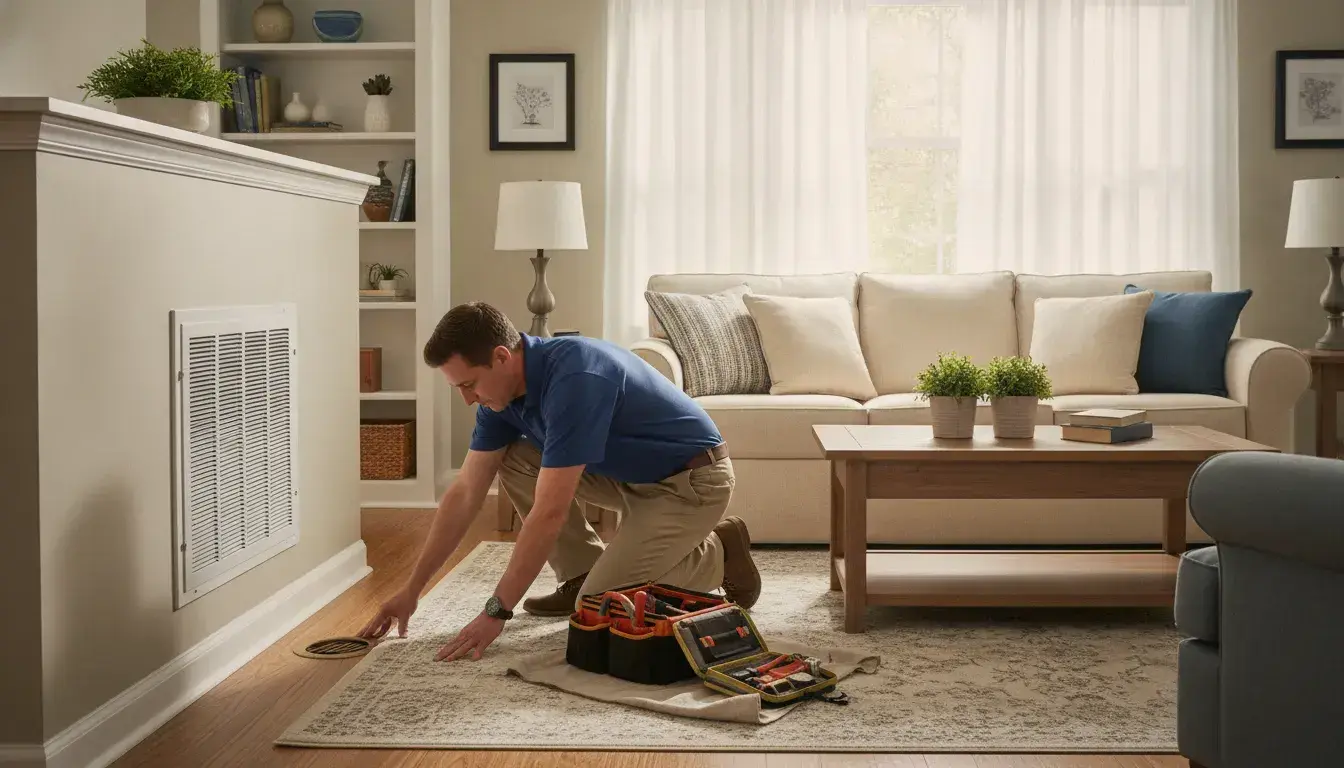
A room that feels stuffy or never quite reaches the thermostat setting does not automatically mean your HVAC system needs replacement. In many Delmarva homes, comfort depends on how air moves through registers, returns, ductwork, and the building envelope.
Call Bay Care at 302-245-3365 to schedule service.
To improve airflow in your home, start with the basics: keep supply registers and return vents open and clear. Check that the filter fits correctly, and look for duct or air-sealing issues that may disrupt pressure. Bay Care’s whole-home approach considers airflow, insulation, air sealing, ventilation, and equipment together, so you can address the actual bottleneck before discussing replacement.
Uneven airflow can come from a surprisingly small obstruction, but it can also signal a deeper distribution or pressure problem. Understanding why some rooms struggle while the system still runs will help you choose the right next step. For the bigger picture, see Bay Care’s guide to whole-home energy efficiency on the Delmarva Peninsula.
Why Is My Home’s Airflow Uneven If the HVAC Still Runs?
Bay Care looks at uneven comfort as a whole-home airflow problem, not automatically as a failing HVAC unit. A system can run while conditioned air is restricted, lost, or poorly distributed through supply registers and return paths. The airflow diagnostic review helps identify the bottleneck before you commit to equipment replacement.
Start with the distribution side of the system. A register that is closed, covered by furniture, or blocked by heavy curtains cannot deliver air effectively into the room. The same is true of a return vent that is dusty or obstructed. Returns draw air back toward the equipment, so a restricted return path can affect circulation throughout the home rather than just the room where the grille is located.
Ductwork is another common variable. A crushed, disconnected, poorly routed, or leaky duct can reduce the air reaching one room while other areas feel comparatively comfortable. Sealing can help when conditioned air is escaping through duct joints or gaps. Cleaning may be more appropriate when buildup inside the duct system is restricting passage or contributing to indoor air quality concerns. These are different services, which is why a diagnosis matters. You can learn more about how to improve airflow through duct sealing when leakage is part of the problem.
Pressure and return-air balance can also change from room to room. Closing a bedroom door may limit the path back to a central return, especially when the room has no dedicated return grille or transfer path. That can create a noticeable difference in temperature and airflow even though the thermostat reaches its setting. Avoid adjusting dampers or entering equipment areas if you cannot clearly identify the components and their purpose.
The home’s envelope matters, too. Air sealing around windows, doors, and ductwork controls where air enters and exits. Insulation, ventilation, moisture, and duct design all influence how comfortable a room feels. An energy audit can identify poor airflow and ventilation weaknesses while providing a targeted improvement roadmap, rather than assuming the answer is a new system.
Bay Care connects those pieces so you can address the cause of uneven airflow instead of treating symptoms one room at a time. For a broader plan, review Bay Care’s whole-home energy efficiency guide before choosing a single equipment change.
How Can You Improve Airflow in Your Home Without Replacing HVAC?
Bay Care recommends starting with simple, safe checks before assuming your HVAC equipment needs replacement. Airflow depends on both supply registers and return paths, so a blocked grille, loaded filter, or closed interior door can affect comfort. This homeowner checklist can help you identify easy corrections while showing when professional help is appropriate.
- Walk through every room. Confirm that supply registers are fully open and that furniture, rugs, boxes, or heavy curtains are not covering them. Conditioned air needs a clear path into the room. Listen for unusual whistling or rattling, but do not remove grilles or reach into ductwork.
- Check the return vents. Return grilles pull room air back toward the HVAC system. Keep them clean and unobstructed, especially if they sit behind furniture or near dusty floor areas. A restricted return can reduce circulation throughout the home and make the system work harder.
- Inspect the filter. Replace or clean the filter according to its instructions when it is visibly loaded, and make sure it fits the filter slot correctly. The right filter depends on the equipment and system design. Do not install an unusually restrictive filter just because its rating is higher. If you are unsure, ask a technician to confirm compatibility.
- Consider room-to-room air paths. A closed bedroom or hallway door can limit circulation when the room has no adequate return path. Leave doors open when practical, or note which rooms become uncomfortable when doors are closed. Do not modify doors, walls, or duct dampers without understanding the system’s design.
- Use ceiling fans for comfort. Ceiling fans can improve how cool a room feels by moving air across your skin, but they do not replace HVAC airflow or fresh-air ventilation. Set the fan for the season and turn it off when the room is unoccupied.
- Compare the result over several cycles. After making these adjustments, observe whether weak airflow or uneven temperatures improve during heating and cooling cycles. Record the rooms affected, the filter condition, and whether the problem changes with doors open or closed. That information gives a technician a more useful starting point.
For seasonal reminders, use this HVAC maintenance checklist alongside your observations.
- Note which rooms feel warm, cool, stuffy, or weakly supplied.
- Record whether the pattern changes when interior doors are open.
- Keep the filter size and replacement date available for the technician.
If the issue remains, avoid opening electrical panels or changing unfamiliar dampers. Bay Care can trace the problem through the filter, return and supply paths, ductwork, and other whole-home factors before recommending a repair, adjustment, or larger improvement.
Can Duct Cleaning and Sealing Improve Airflow Without HVAC Replacement?
Yes, duct service can address airflow problems that originate outside the heating or cooling equipment. Bay Care separates two different needs: cleaning removes accumulated material from the inside of ductwork, while sealing closes unintended gaps that let conditioned air escape. An airflow diagnostic review can help identify which issue is affecting comfort before replacement enters the conversation.
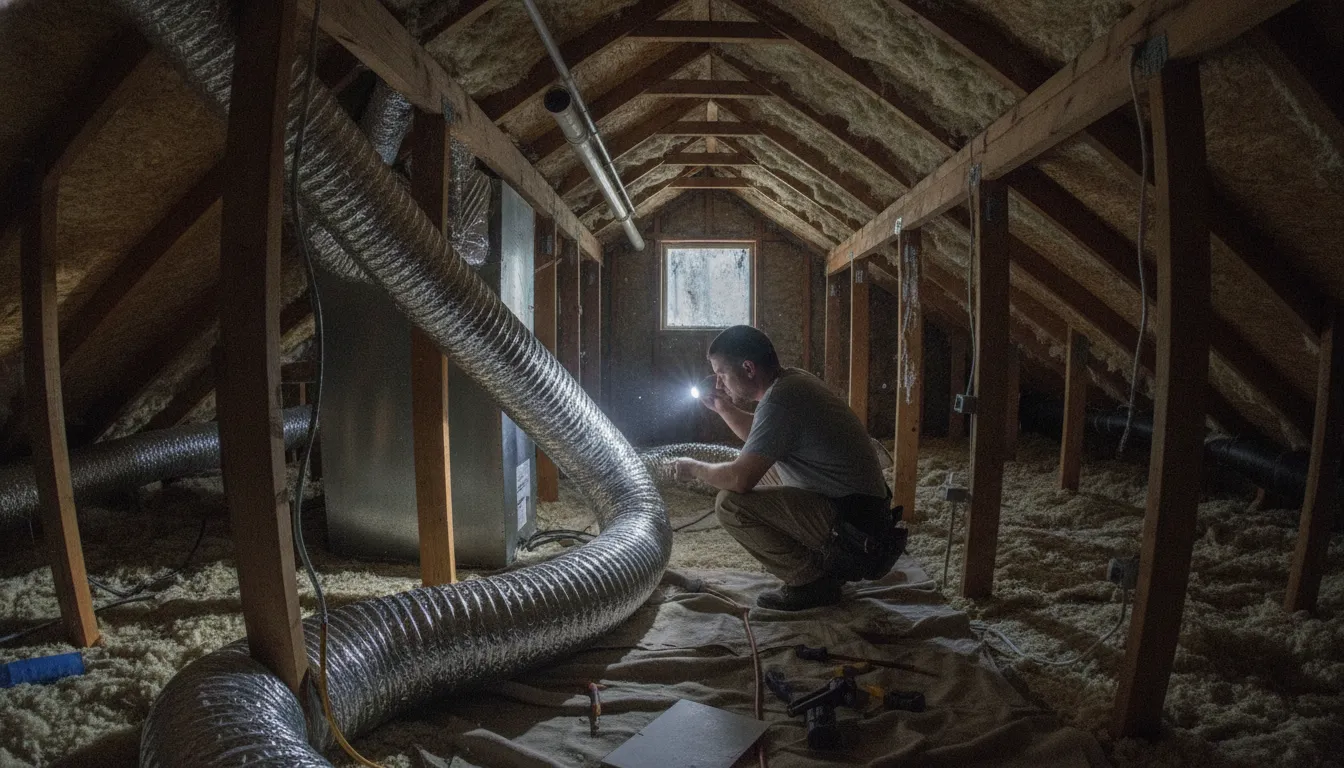
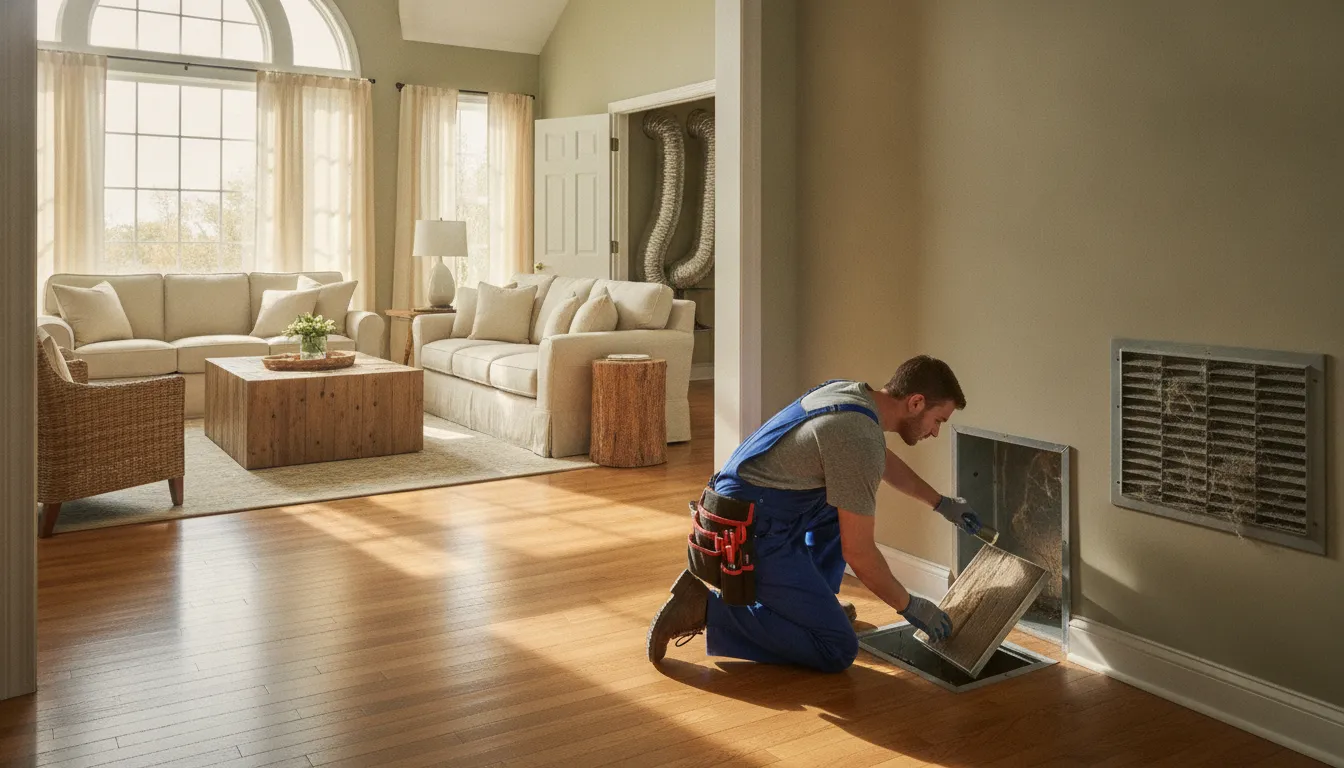
When can duct cleaning help?
Duct cleaning may be appropriate when dust, construction debris, or other accumulated material is restricting a section of the distribution system. It can also make sense after certain renovation work or when visible buildup is present around registers and accessible duct surfaces. However, cleaning is not a universal answer for every weak register. If the duct is undersized, crushed, disconnected, or leaking, removing debris will not correct the underlying distribution problem.
A technician should look for the source of the restriction rather than treating every comfort complaint as a cleaning job. The condition of the filter, return path, supply runs, and equipment should be considered together. Homeowners can learn more about when it makes sense to clean your air ducts to improve airflow, especially in Salisbury and across the Eastern Shore.
When is duct sealing the better solution?
Duct sealing addresses leaks at joints, seams, connections, and other points where air escapes before reaching the intended room. Sealing can be especially relevant when some rooms remain uncomfortable, airflow changes between floors, or ductwork runs through an attic, crawl space, or other unconditioned area. The goal is better control over where conditioned air travels, not simply more force from the blower.
Air sealing is also part of whole-home performance. Sealing leaks around doors, windows, and ductwork helps control where air enters and exits the home. Bay Care evaluates ductwork alongside insulation, air sealing, ventilation, and equipment so a repair in one area does not hide a problem elsewhere.
Cleaning and sealing can sometimes be recommended together, but they solve different problems. A careful assessment should establish whether the priority is a restriction, leakage, poor return-air movement, or a broader design issue. That evidence-based approach may improve comfort without replacing a system that still has useful service life.
How Can Ventilation Improve Airflow and Indoor Air Quality?
Bay Care can help improve airflow in your home by looking beyond the blower and supply registers. Ventilation addresses how stale indoor air leaves and fresh outdoor air enters, while circulation simply moves existing air around. The right approach depends on your home’s pressure balance, duct layout, filtration, and Delmarva’s often humid conditions.
A ceiling fan may make a room feel cooler, but it does not replace outdoor air. Likewise, running a bathroom exhaust fan removes air, yet uncontrolled replacement air can enter through cracks or other unwanted pathways. The CDC explains the difference between circulation and ventilation and recommends increasing outdoor air when practical. During mild, dry weather, opening windows or using a window fan to exhaust air from one room while opening windows elsewhere can support air exchange. Close windows when outdoor heat, humidity, smoke, or allergens would make indoor conditions worse.
| Approach | What it does | Important consideration |
|---|---|---|
| Exhaust ventilation | Removes indoor air through a bathroom fan or kitchen hood. | May draw replacement air through leaks, so moisture and pressure matter. |
| Supply ventilation | Brings outdoor air in through dedicated or central-system-connected ductwork. | Outdoor air may need filtration or moisture control before distribution. |
| Balanced ventilation | Exhausts indoor air while bringing in a similar amount of outdoor air. | Helps maintain more neutral pressure when properly designed. |
| Dehumidifying ventilation | Conditions incoming outdoor air to remove moisture before it enters. | Can be useful where humid outdoor air would otherwise undermine comfort. |
Humidity deserves special attention in coastal Maryland and Delaware. The EPA recommends controlling moisture and keeping indoor humidity below 60%, with 30% to 50% as an ideal range. Its indoor air quality guidance also groups source control, adequate ventilation, and filtration as complementary strategies. In a humid home, ventilation alone may bring in more moisture than the air conditioner can comfortably manage. Filtration can supplement ventilation, but it does not remove humidity or replace fresh-air exchange.
Bay Care’s whole-home approach considers ventilation alongside returns, ductwork, air sealing, insulation, and equipment. An airflow diagnostic review can help identify whether the priority is a blocked pathway, uncontrolled leakage, inadequate fresh-air exchange, or moisture management. Improvements can then address the cause rather than simply adding another fan.
When Does Zoning Solve a Room-by-Room Comfort Problem?
Bay Care can help determine whether zoning or ductless HVAC is appropriate when one part of a home consistently feels different from the rest. The right solution depends on the room’s use, duct layout, insulation, air sealing, and heating and cooling load. An airflow diagnostic review should guide that decision, rather than assuming replacement is necessary. Review Bay Care’s residential HVAC and home performance services for the broader options available.
Zoning divides a central HVAC system into separate comfort areas, often called zones. Each zone has its own thermostat, and controls direct conditioned air where it is needed. In a two-story Delmarva home, for example, the upper floor may gain heat faster than the main level. A converted attic, addition, sunroom, or rarely used guest area may also behave differently from the original floor plan.
That does not mean every uneven room needs zoning. A closed or obstructed register, a dirty filter, a restricted return path, a damaged duct, or air leakage can create similar symptoms. Closing several vents in an attempt to force more air elsewhere can also upset the system’s pressure balance. These simpler causes should be checked before adding controls or changing how the system distributes air.
When is ductless a better fit?
A ductless mini-split can be useful when a room or separate area has no practical ductwork, has a distinct schedule, or needs independent temperature control. It may suit a home addition, detached workspace, finished room, or isolated upper level. Because the indoor unit serves a targeted area, ductless can address a room-specific comfort concern without extending the central duct system through difficult spaces.
Ductless is not automatically the best answer. The location of the outdoor unit, electrical requirements, condensate management, exterior appearance, and the home’s overall load still matter. In coastal communities, equipment also faces salt-air exposure, so installation planning should account for the environment. A professional should evaluate the space and the existing system together.
For homeowners trying to improve airflow in your home, zoning and ductless are targeted options, not shortcuts around diagnosis. Bay Care looks at the distribution system and the home as a whole, then explains whether balancing, ductwork, ventilation, controls, or supplemental conditioning best matches the problem. That approach helps keep the next step focused on the room that needs attention without overlooking the rest of the house.
What Does Bay Care’s airflow diagnostic review Check?
Bay Care’s airflow diagnostic review is the decision point before replacing an HVAC system. It looks for the cause of comfort problems across the home, so a repair, duct improvement, ventilation change, or other targeted solution can be considered before a replacement. The assessment is especially useful when one room stays uncomfortable, registers feel weak, or the system runs without distributing air evenly.
Bay Care’s NATE-certified technicians consider the equipment as part of a larger system. That whole-home perspective connects the HVAC unit with ductwork, insulation, air sealing, ventilation, and the building envelope. A professional energy audit and home performance evaluation can help identify airflow bottlenecks and ventilation weaknesses without assuming new equipment is the answer.
What may be inspected?
The technician may begin with the filter, return path, and supply registers. A dirty or poorly fitted filter can restrict the air the system is able to move. Blocked returns, closed registers, furniture, or heavy curtains can also interfere with circulation. These simple conditions matter because a blower cannot distribute conditioned air effectively if the path into or through the system is restricted.
The assessment may then follow the air path through accessible ductwork. The technician can look for visible damage, disconnection, insulation concerns, or signs that leakage or restriction could be contributing to uneven temperatures. This is different from assuming that every airflow complaint requires duct cleaning. The appropriate service depends on what the inspection reveals.
How does the assessment guide the next step?
Comfort patterns provide important context. Tell the technician which rooms are too warm or too cool, whether the problem changes by season, and whether it affects an addition, upper floor, or closed-off area. Those observations help connect symptoms with possible distribution, pressure, insulation, air-sealing, or equipment concerns.
When appropriate, the technician may use pressure or restriction clues to narrow the problem. But the goal is not to promise a particular outcome before the home is evaluated. If a targeted correction can address the issue, Bay Care can explain that path. If the system is undersized, too old, or fundamentally unable to meet the home’s needs, replacement can be discussed with clearer evidence. That sequence helps homeowners improve comfort while avoiding an unnecessary equipment decision.
Contact Bay Care to schedule an airflow evaluation or discuss your next step.
Frequently Asked Questions
How can I improve airflow in my home without replacing my HVAC system?
Start with simple checks: replace a dirty filter with the correct size, clear supply registers and return vents, and move furniture or curtains away from grilles. If comfort remains uneven, duct cleaning, duct sealing, air sealing, or a professional assessment may address the restriction without replacing the equipment.
Why does one room in my house not get good airflow?
A weak room may have a blocked register, an obstructed return path, a restricted or leaking duct, or a layout that makes the room harder to serve. Closed doors can also limit return airflow. Bay Care can trace the pattern through an airflow diagnostic review instead of guessing at a replacement.
Does cleaning air ducts improve home airflow?
It can help when dust, debris, or another obstruction is restricting the duct interior, but cleaning will not repair a disconnected or leaking duct. Sealing addresses unwanted air loss, while cleaning addresses contamination or buildup. The right service depends on what an inspection finds.
Can box fans help improve ventilation and airflow?
Yes, a window fan can exhaust stale indoor air while windows in other rooms remain open, creating a basic air exchange path. That is ventilation, not merely circulation. The CDC distinguishes ventilation from moving air within a room and recommends this window-fan arrangement when conditions are appropriate: CDC ventilation guidance.
Should I close vents in unused rooms to improve airflow elsewhere?
Usually, no. Closing several registers can alter the system’s pressure balance and does not guarantee that more useful air will reach another room. Keep registers open and unobstructed unless an HVAC professional recommends a specific adjustment. Bay Care can evaluate the distribution problem and identify a safer, targeted solution.
Schedule an Airflow Conversation With Bay Care.
If your home still has uneven rooms, weak registers, or lingering comfort concerns after the basic checks, contact Bay Care for a focused conversation about what your system and ductwork are doing. Bay Care can help you decide whether an adjustment, duct service, ventilation change, zoning option, or airflow diagnostic review fits your Delmarva home.
Call to discuss the symptoms and schedule the appropriate service assessment.


